
Adventure Within Reach
Ao Nang, Thailand places extraordinary landscapes within reach, where limestone cliffs, tropical seas and endless possibilities make curiosity almost impossible to resist
Sometimes we arrive somewhere and immediately understand why people come.
Ao Nang, Thailand was like that.
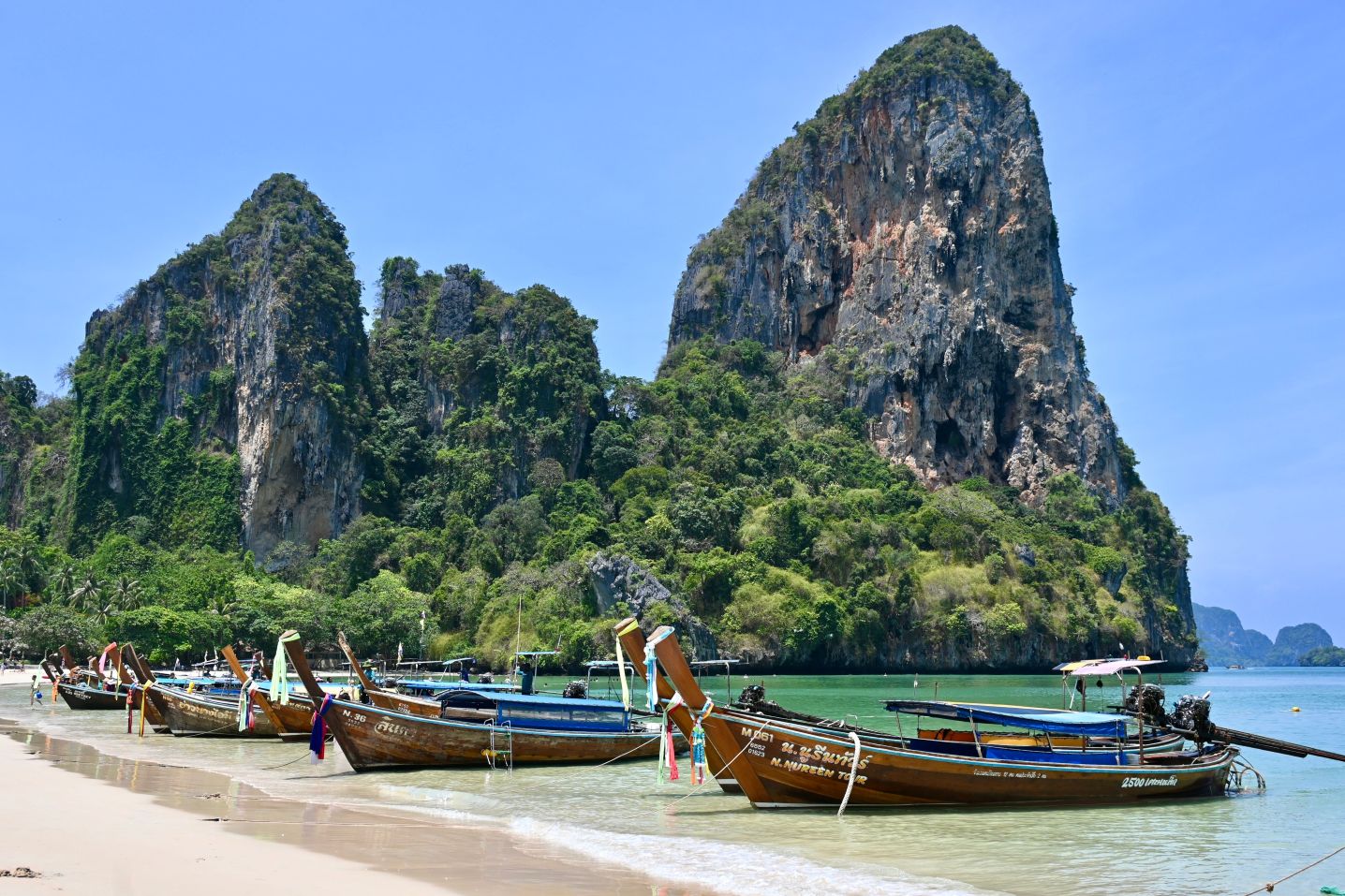
There was no slow reveal and very little need to search for its appeal. Towering limestone formations rose behind the town, their steep green faces appearing almost impossibly close to the streets below. Ahead of us was the Andaman Sea, dotted with islands and rock formations that seemed to continue towards the horizon. Long-tail boats rested in the shallows, their bows pointing towards beaches that couldn't be reached by road.
After months travelling through Southeast Asia, we had seen tropical beaches, dramatic mountains and beautiful islands before.
Ao Nang somehow brought all of them together.
Yet the longer we stayed, the more we realised that the thing we loved most wasn't any single landscape.
It was possibility.
Every morning seemed to begin with the sense that something extraordinary was waiting just beyond where we could see. A boat could carry us around the headland to Railay. A road inland could lead towards a mountain temple and more than a thousand steps disappearing into the jungle above us. Beyond the beach were islands, coral reefs and limestone formations scattered across the sea.
Ao Nang didn't feel like the end of a journey.
It felt like the beginning of dozens of them.
Where the Mountains Meet the Sea
Long before resorts, restaurants and tour boats came to define modern Ao Nang, the landscape was already writing the story.
Krabi's coastline is dominated by limestone formations shaped over immense periods of geological time. Water, weather and erosion gradually carved cliffs, caves, headlands and isolated towers from the rock, creating a coastline that can sometimes feel more imagined than real.
Human life adapted around that geography.
Communities across this part of southern Thailand were historically connected to the sea, fishing, farming and moving between coastal settlements and islands long before tourism transformed places such as Ao Nang. The wider Krabi region still carries traces of those older relationships with land and water, even as millions of visitors now come seeking the extraordinary scenery they created.
Ao Nang's transformation has been particularly dramatic.
What was once a comparatively quiet coastal community has become one of Krabi's principal tourism centres and, more importantly, a gateway to the landscapes surrounding it. Hotels and restaurants now line roads where the rhythms of life were once determined far more by fishing, tides and agriculture than check-in times and boat schedules.
It would be easy to look at that development and conclude that the original Ao Nang has disappeared.
But the geography refuses to let modernity completely take over.
The cliffs are simply too large.
The sea is too present.
Walk towards the beach and the buildings eventually stop. The horizon opens. Long-tail boats gather along the shoreline, still using a form of transport perfectly suited to these waters, and suddenly the landscape becomes dominant again.
That was the Ao Nang we connected with.
Not simply a beach town, but a place where civilisation seems to have negotiated its position between mountains and sea.
The Boats at the Beach
There are few sounds we associate more strongly with southern Thailand than a long-tail boat engine starting in shallow water.
Ao Nang Beach has plenty of them.
They wait close to shore, brightly coloured ribbons wrapped around their bows, before pushing away from the sand and turning towards the limestone headlands that dominate the coastline.
Some are carrying people towards nearby islands.
Others are heading around the enormous rock formations towards Railay.
Watching them leave creates an almost irresistible curiosity.
So eventually we climbed aboard one.
The journey from Ao Nang to Railay is short, but distance has very little to do with how dramatically the landscape changes. Ao Nang gradually recedes behind the boat while limestone cliffs grow larger ahead, rising almost vertically from the Andaman Sea.
Then the boat curves around the headland and Railay appears.
There is no road connecting it to Ao Nang. The surrounding cliffs make the peninsula effectively inaccessible by vehicle, so arriving from the sea remains part of the experience.
We stepped from the long-tail boat into shallow water and walked towards a beach framed by some of the most dramatic limestone scenery we had encountered anywhere in Thailand.
The water was calm. The cliffs seemed almost impossibly close. Kayaks moved beneath rock formations while climbers made their way slowly up vertical faces high above us.
Railay didn't feel particularly remote in kilometres.
It felt remote because geography had protected the experience of arriving there.
Perhaps that is part of what makes this corner of Thailand so compelling.
The landscape still dictates the journey.
Looking Up
Krabi constantly makes us look upwards.
From the beach, limestone cliffs dominate the horizon. From a long-tail boat, enormous rock formations rise directly from the sea. At Railay, climbers disappear slowly towards the tops of vertical walls.
Then there is Tiger Cave Temple.
Wat Tham Suea sits inland from Ao Nang, and from ground level the challenge above is difficult to fully comprehend.
There are 1,260 steps to the summit.
Calling them steps is perhaps generous.
Some are narrow. Others are remarkably steep. In the tropical humidity, the climb quickly becomes less of a walk and more of a negotiation between determination and common sense.
We had already experienced plenty of moments during our travels when curiosity had persuaded us to do something physically uncomfortable.
This was another.
The climb gradually strips away any romantic ideas about effortlessly reaching a mountain temple. Sweat replaces conversation. Legs begin questioning the decisions made by the brain. Numbers painted along the route become milestones that are celebrated briefly before revealing just how many still remain.
At around step 900, the summit still felt a very long way away.
But eventually the stairs ended.
And Krabi opened beneath us.
From the summit, the landscape we had been experiencing at ground level finally made sense. Limestone mountains rose from an enormous green landscape. Roads and buildings became insignificant. The coastline stretched towards the Andaman Sea while distant islands appeared as fragments scattered across the horizon.
Far below was the world we had climbed away from.
Above us, almost nothing.
Travel regularly reminds us that effort changes appreciation.
The view would have been spectacular regardless of how we reached it.
But climbing 1,260 steps made us earn the privilege of standing there.
When Nature Changes the Plan
Of course, living beside the Andaman Sea also means accepting that nature rarely consults our itinerary.
One of our days on the water was supposed to deliver the classic southern Thailand experience: islands, swimming, warm tropical seas, dinner and a spectacular sunset.
Instead, the weather began changing.
The sea became rougher. Rain arrived. The comfortable tropical boat journey we had imagined became considerably more adventurous as we moved across increasingly choppy water.
The sunset never really appeared.
By the time we returned, we were wet, cold and very aware that the Andaman Sea can change character quickly.
And yet we still remember the day fondly.
Perhaps because travel becomes much more interesting once we stop demanding perfection from it.
The photographs that dominate our screens have conditioned us to expect destinations at their most beautiful. Turquoise water. Empty beaches. Perfect sunsets. Calm seas.
Real places don't exist permanently in those conditions.
Clouds gather.
Rain falls.
Boats bounce across rough water.
Plans change.
Sometimes the sunset doesn't happen.
None of that makes the place less beautiful.
It simply makes the experience real.
Between Adventure and Ordinary Life
One of the reasons Ao Nang worked so well for us was that adventure never felt far away, but neither did ordinary life.
We stayed for five nights in a one-bedroom apartment at Silk Condominium, set slightly above the busier streets below. We had a kitchen, lounge, washing machine and balcony overlooking the pool, with the green hills behind Ao Nang completing the view.
After months of travelling, those simple comforts had become increasingly valuable.
We could spend a day climbing mountains or crossing the Andaman Sea and then come home, wash our clothes, make a coffee and sit quietly on the balcony.
There was no contradiction between the two.
That balance has become increasingly important to the way we travel.
When holidays are short, accommodation can simply be somewhere to sleep between experiences. When travel becomes life, the place we return to matters differently. We need occasional normality between the extraordinary moments.
Ao Nang gave us both.
The town itself could be lively. Restaurants, cafés, shops and tour operators filled the streets closer to the beach. Boats came and went throughout the day. Travellers arrived carrying backpacks while others departed with suitcases rolling behind them.
But move slightly away from that energy and the landscape quickly returned.
The mountains were always there.
A reminder that adventure was never particularly far away.
A Gateway Rather Than a Destination
Perhaps this is what we initially misunderstood about Ao Nang.
We thought we were travelling to it.
In reality, we were travelling through it.
Not in the sense that Ao Nang wasn't worth staying in, because it became one of our favourite locations in Thailand. Rather, its greatest strength was the way it connected us to everything surrounding it.
Ao Nang Beach led to long-tail boats.
The boats led to Railay.
The coastline opened onto islands.
The roads inland led towards temples and mountains.
Every direction seemed to offer another version of Krabi.
There are destinations where the attraction lies within clearly defined boundaries. We arrive, explore them and eventually feel we have seen what we came to see.
Ao Nang never really gave us that feeling.
The more we experienced, the more possibilities appeared.
Perhaps that is why five nights felt both full and nowhere near enough.
The Landscape Sets the Rules
Modern travel gives us an extraordinary illusion of control.
We can book accommodation months ahead, map routes to the minute, read thousands of reviews, check weather forecasts and build itineraries detailed enough to account for almost every hour.
Then we arrive somewhere like Krabi.
A cliff blocks the road, so we take a boat.
A mountain puts a temple at its summit, so we climb.
The tide changes, revealing or hiding parts of the coastline.
The weather turns, transforming a sunset cruise into something entirely different.
Suddenly nature is setting the itinerary again.
There was something refreshing about that.
Ao Nang reminded us that some of the world's most memorable destinations remain extraordinary precisely because we haven't completely conquered them.
Railay is still reached from the sea.
The limestone cliffs still dictate where roads can and cannot go.
The islands remain separated by stretches of open water.
The summit of Tiger Cave Temple still demands 1,260 steps from anyone wanting to stand above the landscape.
We can make these places easier to visit.
We cannot make them ordinary.
Why Ao Nang Stayed With Us
We have visited many beautiful places since beginning our full-time travels.
Some are remembered for a particular experience.
Others for a landscape, a person we met or something unexpected that happened while we were there.
Ao Nang is harder to reduce to one memory.
Perhaps because the experience constantly changed perspective.
We saw Krabi from the beach, looking towards the islands.
We saw it from a long-tail boat, with limestone cliffs rising beside us.
We stood beneath those cliffs at Railay and understood their scale.
We climbed high above them at Tiger Cave Temple and watched the entire landscape spread beneath us.
We crossed the sea when it was calm and experienced it when the weather decided otherwise.
Each perspective revealed something different.
Together they created a sense that we weren't simply visiting a destination.
We were moving through a landscape.
That distinction matters.
Ao Nang didn't need to be the most beautiful beach we had ever visited or the most culturally significant town on our journey.
It gave us something more valuable.
Access to wonder.
Final Reflection
There are places we remember because of what we found there.
Ao Nang will stay with us because of everything it placed within reach.
A boat waiting at the shoreline.
A beach hidden beyond a limestone headland.
A cliff disappearing towards the sky.
A staircase climbing through tropical heat.
An island sitting somewhere beyond the horizon.
The possibility of another adventure seemed to exist in almost every direction.
Perhaps that is what made Ao Nang one of our favourite places in Thailand.
It reminded us that curiosity doesn't always require travelling enormous distances. Sometimes we simply need to position ourselves somewhere that makes exploration irresistible.
Ao Nang was that place for us.
We arrived beside the Andaman Sea.
And every direction seemed to lead somewhere extraordinary.
With curiosity,
G&T
Find stories and insights that inspire your own path forward
Discover insights that elevate your travel, sharpen your leadership, and support your personal growth..


Join Our Adventure Today!
Stay updated with our latest travel stories, tips, and adventures. Join our newsletter!