
Beyond the Big 5
Three days on Borneo's Kinabatangan River transformed our understanding of wildlife tourism, conservation, and shared responsibility.
We arrived on the Kinabatangan River with the same goal as many travellers who venture into the rainforests of Malaysian Borneo.
We wanted to find the Big 5.
Orangutans. Pygmy elephants. Proboscis monkeys. Rhinoceros hornbills. Estuarine crocodiles.
Like many wildlife experiences, our expectations revolved around a checklist. We measured success by the number of animals we hoped to see and the photographs we imagined taking home.
Three days later, we left with a very different understanding of what wildlife travel should be.
The animals brought us to Borneo.
The people protecting them are the reason we'll never forget it.
The Kinabatangan River: A Wildlife Corridor Under Pressure
Flowing through eastern Sabah, the Kinabatangan River is one of Southeast Asia's most important wildlife corridors. Its tea-coloured waters weave through a mosaic of rainforest, wetlands, floodplains, and oxbow lakes that support an extraordinary concentration of biodiversity.
Despite covering only a small portion of Sabah, the Kinabatangan floodplain provides habitat for around 10 per cent of Borneo's mammal species and is one of the few places on Earth where travellers have a realistic chance of encountering the Borneo Big 5 in the wild.
Yet the Kinabatangan is more than a remarkable wildlife destination.
It is also a living example of both the fragility and resilience of nature.
Over recent decades, large areas of Borneo's lowland rainforest have been cleared for agriculture and development, fragmenting habitats that once stretched uninterrupted across the landscape. For species such as orangutans and pygmy elephants, these isolated pockets of forest create significant challenges, limiting access to food, breeding opportunities, and safe migration routes.
The work of reconnecting and protecting these habitats is ongoing and depends on collaboration between local communities, conservation organisations, tourism operators, researchers, and government agencies.
Every wildlife sighting on the Kinabatangan is a visible reminder of invisible conservation work.
The Search Begins
We based ourselves at Borneo Natural Sukau Bilit Resort, a riverside lodge offering guided wildlife experiences along the Kinabatangan River.
From our first river cruise, one thing became immediately clear.
Nothing here is guaranteed.
There are no feeding schedules, designated viewing areas, or fenced enclosures. The animals decide if and when they reveal themselves.
That uncertainty transforms the experience.
Instead of expecting wildlife, you learn to appreciate it.
Instead of consuming nature, you become a guest within it.
Late on our first afternoon cruise, our guide, Kai, pointed silently towards the treetops.
A troop of proboscis monkeys sat high in the canopy, their unmistakable silhouettes framed against the fading light.
One down. Four to go.
Watching the Rainforest Wake Up
Before sunrise the following morning, we climbed back into the boat and set off along the river.
As dawn broke across the Kinabatangan, the rainforest slowly came alive around us. Bird calls echoed through the canopy while mist drifted above the water.
Then we saw movement.
High above us, a mother orangutan and her baby emerged from their overnight nest.
We watched quietly as they began their day together.
What struck us wasn't simply the privilege of seeing orangutans in the wild. It was the realisation that moments like this only exist because someone, somewhere, chose to protect the habitat that makes them possible.
A short time later, we spotted an estuarine crocodile basking silently on the riverbank.
Then came one of our favourite moments of the trip.
Two rhinoceros hornbills landed together in a nearby tree and gently touched beaks in what looked remarkably like affection.
Within a single sunrise cruise, we had encountered four of Borneo's Big 5.
Only one remained.
The Turning Point: Planting for the Future
That afternoon, we joined an optional tree-planting activity organised through the resort.
For 30 MYR (approximately AUD $10) per person, we carried saplings into the forest and planted them in an area being restored as a wildlife corridor.
Until that moment, conservation had felt like an important but distant idea.
Suddenly, it became tangible.
We learned how fragmented habitats restrict animal movement and increase the challenges faced by species already under pressure. We learned how local communities are working to reconnect isolated pockets of forest. We learned that even a single tree can play a small role in restoring ecosystems over time.
Our contribution was modest.
But our perspective shifted.
We arrived believing great wildlife experiences were measured by the number of animals we saw.
We left understanding they should be measured by something else entirely.
Whether our visit helps protect the places and people that make those encounters possible.
The Elephant We Almost Missed
By the final afternoon, we still hadn't seen the fifth member of the Big 5.
The Bornean pygmy elephant.
As daylight faded and Kai turned the boat back towards the resort, we accepted that this might be one encounter we would miss.
Then someone spotted movement in the river.
At first, it looked like a large rock.
Then the rock moved.
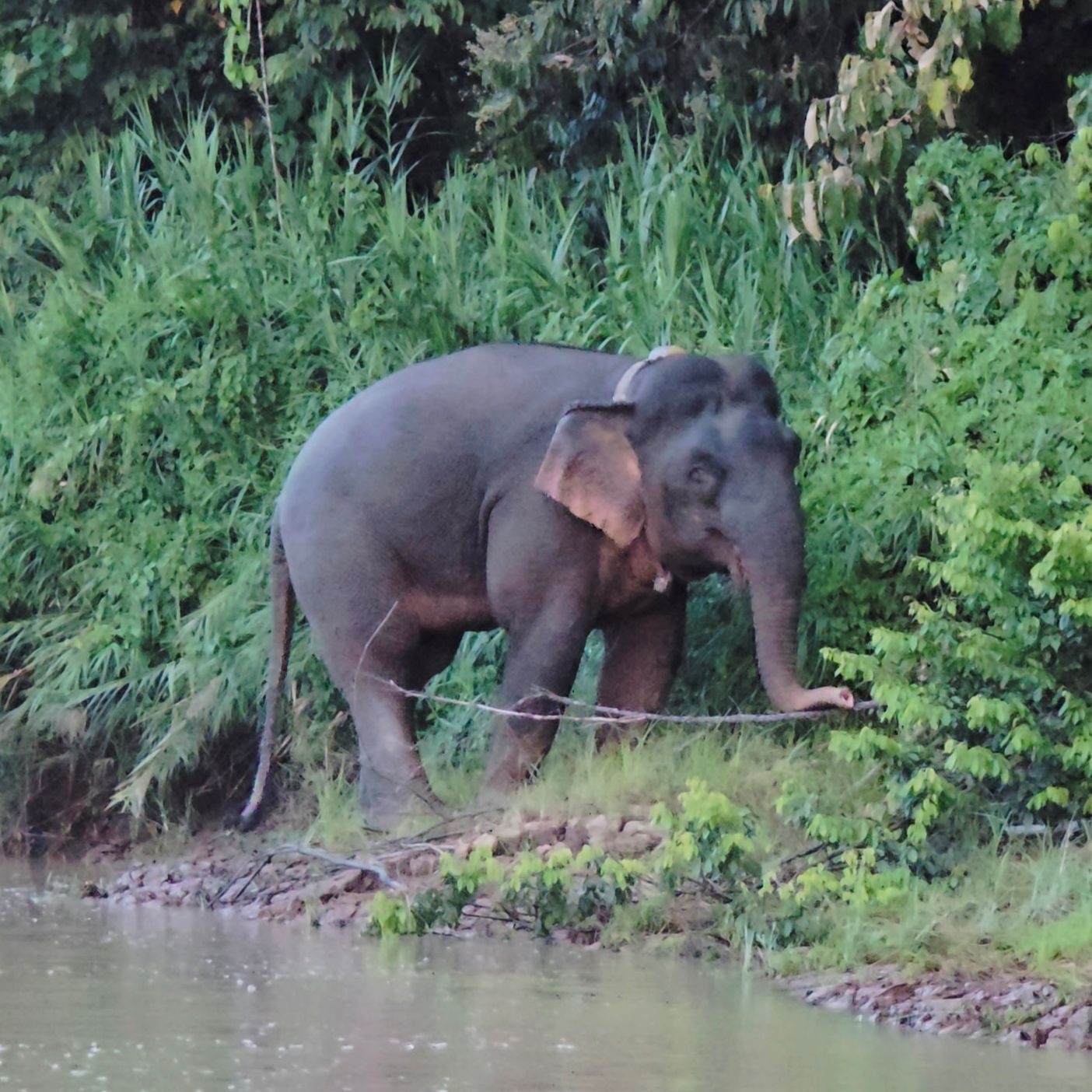
We watched in complete silence as a pygmy elephant swam gracefully across the Kinabatangan River, climbed onto the opposite bank, paused briefly to look towards us, and disappeared back into the forest.
It felt like Borneo's final gift.
Later, we learned his story.
His name is Elvis.
A survivor of poaching attacks, Elvis lost one of his tusks and now lives largely apart from the herd. Conservation teams fitted him with a GPS tracking collar to monitor his movements and help ensure his ongoing safety.
What initially felt like the perfect ending to our search became something much more profound.
Every wildlife encounter has a story behind it.
And every story depends on people working tirelessly to ensure these animals continue to survive in the wild.
The People Behind the Wildlife
Our final memory of the Kinabatangan wasn't an animal.
It was a conversation.
Before leaving, Trina sat down with Kai, our guide and river skipper.
For the past nine years, he has introduced visitors from around the world to the biodiversity of the Kinabatangan River.
When asked what he loves most about his job, his answer was simple.
"The wildlife."
When asked what message he would share with the world, his response was even simpler.
"We need more trees."
Not more roads.
Not more buildings.
More trees.
Without healthy forests, there is no habitat.
Without habitat, there is no wildlife.
And without wildlife, places like the Kinabatangan lose the very thing that makes them extraordinary.
Kai reminded us that conservation isn't a concept.
It's people.
People who dedicate their lives to protecting places they care deeply about.
What We Got Wrong About Wildlife Travel
Before arriving in Borneo, we thought the success of a wildlife experience was measured by what we saw.
Today, we believe it's measured by what we support.
Responsible wildlife tourism isn't simply about ticking animals off a list.
It's about understanding what it takes to protect them.
It means choosing operators that invest in conservation, supporting local communities, respecting wildlife, and recognising that our presence as travellers has an impact, whether positive or negative.
The goal isn't simply to see extraordinary places.
It's to help ensure they remain extraordinary.
Planning Your Own Borneo Big 5 Adventure
Location: Kinabatangan River, Sabah, Malaysian Borneo
Duration: 3 days / 2 nights
Cost: Approximately AUD $455 per person
Included:
- Return transfers from Sandakan
- Two nights' accommodation
- All meals
- Four guided river cruises
- One guided jungle trek
Optional experiences:
- Tree planting: 30 MYR (approximately AUD $10)
- Night jungle walk: AUD $10
- Night river cruise: AUD $20
If you visit the Kinabatangan River, come with curiosity, patience, and realistic expectations.
Wildlife encounters are never guaranteed.
That uncertainty is precisely what makes them so special.
The Borneo Big 5 may be the headline attraction.
But the future of these extraordinary animals depends not on the animals themselves, but on the people fighting every day to protect them.
With conservation,
G&T
Find stories and insights that inspire your own path forward
Discover insights that elevate your travel, sharpen your leadership, and support your personal growth..

Join Our Adventure Today!
Stay updated with our latest travel stories, tips, and adventures. Join our newsletter!