
Freedom Means Staying
Langkawi taught us that travel isn't always about moving forward; sometimes freedom is recognising when you've found somewhere worth staying.
There is a strange contradiction at the heart of long-term travel. We left our old lives partly because we wanted the freedom to keep moving, yet some of the places we have appreciated most have been the ones that made us want to stop.
Langkawi was supposed to be seven nights.
By the time we arrived, moving had become second nature. We had spent months travelling through Indonesia before crossing into Malaysia, gradually becoming accustomed to the rhythm of arriving somewhere new, unpacking our backpacks, exploring, packing again and moving on. There was always another town, another island, another experience waiting somewhere ahead of us, and in the early stages of full-time travel there was something intoxicating about that constant sense of possibility.
Langkawi seemed likely to follow the same pattern. We would explore the island, spend some time at the beach, seek out a few adventures, enjoy the sunsets and then continue north towards Thailand.
Except we didn't leave.
Seven nights became fourteen. Fourteen became twenty-one. Eventually, we stayed for twenty-eight.
It wasn't because we discovered an endless list of attractions we needed to complete. In many ways, it was the opposite. Langkawi gradually removed the feeling that we needed to be doing anything at all.
And somewhere in that transition, the island taught us something we hadn't expected to learn so early in our travels.
Freedom isn't always about having somewhere else to go.
Sometimes it is about realising there is no reason to leave.
The Pressure to See Everything
Travel has a peculiar way of turning freedom into obligation.
We travel because we want to escape routine, yet almost immediately we begin creating another one. There are beaches we should visit, viewpoints we should climb, restaurants we should try, photographs we should take and experiences we should somehow squeeze into the finite number of days we have allocated to a destination.
For years, that made perfect sense to us. Holidays were limited by annual leave and return flights. If we had seven days somewhere, those seven days mattered. There was an understandable desire to make the most of them because the countdown towards going home began almost as soon as we arrived.
Full-time travel changes that equation, but it takes time for the mind to catch up.
When the holiday no longer ends, trying to travel as though every day is a holiday becomes exhausting.
Langkawi was one of the first places where we really began to understand the difference.
The island certainly gave us plenty of reasons to explore. There were long stretches of beach washed by the warm waters of the Andaman Sea, forested mountains rising behind the coastline and smaller islands scattered across the horizon. Boats disappeared between them during the day and returned as the afternoon light began to soften. Tropical weather could transform the landscape within minutes, turning blue skies grey before releasing rain across the sea and then, sometimes, offering a spectacular sunset as if nothing had happened.
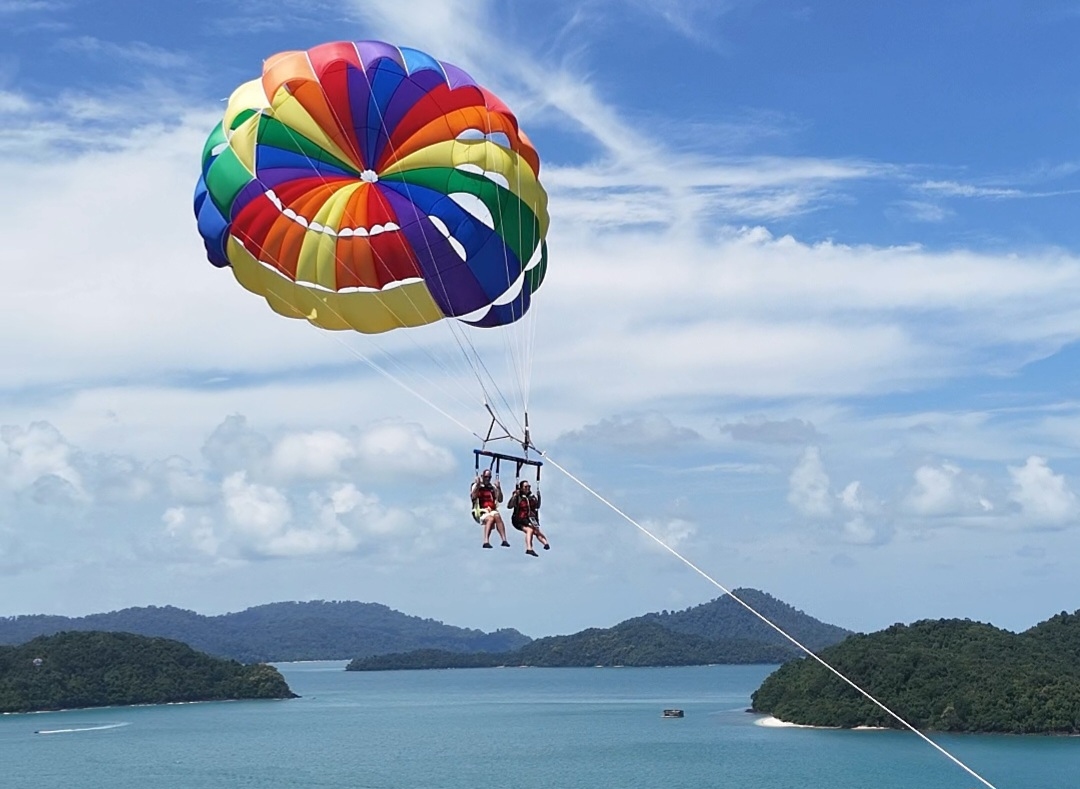
There were days when curiosity pulled us towards adventure. We found ourselves out on the water, looking back towards an island that appeared completely different from the sea. At other times we saw Langkawi from high above the coastline, where beaches, forest and water merged into a much larger landscape and the scale of the archipelago finally became apparent.
We swam. We explored. We went looking for those experiences that had drawn travellers to tropical islands long before we arrived.
But increasingly, we also did something else.
We stopped looking.
When an Island Becomes Familiar
We based ourselves near Pantai Cenang at Casa Fina Fine Homes, originally booking a chalet-style room for just one week. It was comfortable, uncomplicated and close enough to the beach, restaurants and shops that everyday life required very little effort.
Perhaps that simplicity contributed to what happened next.
There was no dramatic conversation where we decided Langkawi deserved another three weeks. We simply reached the end of our original booking and weren't ready to leave.
So we extended.
Then extended again.
As the days accumulated, something subtle began happening. Langkawi stopped feeling like somewhere we were visiting and started feeling like somewhere we were temporarily living.
The difference is difficult to appreciate until you stay somewhere long enough to experience it.
When we first arrive in a new destination, almost everything demands attention. Streets are unfamiliar. Restaurants need researching. Maps are constantly opened. Every corner offers the possibility of discovery and even something as simple as finding a supermarket becomes part of the adventure.
Time gradually removes that novelty.
The road back to our accommodation became familiar. We stopped needing directions. Certain cafés and restaurants became places we returned to rather than places we discovered. Shopkeepers and surroundings became recognisable. The beach was no longer somewhere we needed to visit because it would still be there tomorrow.
And strangely, as Langkawi became less novel, we began enjoying it more.
The Luxury of an Ordinary Day
Some of our favourite days in Langkawi would make terrible travel content.
There was no extraordinary itinerary. No collection of must-see attractions. No carefully planned route designed to maximise every available hour.
We might walk to the beach, find somewhere for coffee, spend time working on G&T's World, wander through the shops, have a drink somewhere in the afternoon and eventually decide what we felt like eating that evening. Another day might bring an adventure on the water or take us somewhere new across the island. Sometimes the weather decided for us, tropical rain sweeping through and quietly rewriting whatever plans we thought we had.
There was room for both.
That became the beauty of Langkawi.
Adventure didn't disappear simply because we slowed down. If anything, it became more enjoyable because it stopped carrying the weight of expectation. We didn't need every day to produce a memorable experience because we knew another day was coming.
A boat trip through the islands could simply be a beautiful afternoon rather than something we needed to extract maximum value from. Swimming in warm tropical water didn't need to be followed by three other activities. Watching the sky change colour over the Andaman Sea could be enough.
Even when plans went wrong, as they inevitably do when boats, weather and island life collide, there was little frustration.
We had time.
Perhaps those three words explain our relationship with Langkawi better than anything else.
We had time.
When Tomorrow Stops Being a Deadline
Time changes the way we see places.
When tomorrow is departure day, everything feels urgent. There is always one more thing we could have done, somewhere else we could have visited, another experience we might regret missing.
When tomorrow is simply another day, something different happens.
We begin noticing rather than searching.
The heat becomes part of the rhythm rather than something to endure between attractions. The sea looks different depending on the hour. Afternoon clouds gather over the mountains. The energy around Pantai Cenang shifts as the day progresses, from quiet mornings to busier afternoons and warm evenings when people emerge to eat, walk and watch the last light disappear across the water.
We began recognising the difference between a day spent doing nothing and a day spent simply enjoying where we were.
They are not the same thing.
That distinction has become increasingly important to us as full-time travellers.
There is a temptation to measure travel through accumulation. Countries visited. Cities explored. Attractions completed. Photographs taken. Experiences collected. Movement itself can begin to feel like progress.
Yet the longer we travel, the less convinced we are that movement and discovery are the same thing.
Sometimes constantly leaving prevents us from discovering the place we are already in.
Langkawi gave us permission to stay long enough to find out.
More Than the Postcard
Like many tropical islands, Langkawi is easy to reduce to photographs.
Blue water. Palm trees. Beaches. Boats silhouetted against sunsets. Forest-covered islands rising from the Andaman Sea.
Those images are real. We saw them too.
But they aren't what ultimately made us stay.
The Langkawi we remember is quieter than the postcard.
It is the feeling of walking outside without an itinerary. Of knowing there is nowhere we urgently need to be. Of recognising the road ahead rather than checking Google Maps. Of returning somewhere because we enjoyed it yesterday. Of watching tropical rain move across the horizon and accepting that whatever we had planned could wait.
It is also the contrast.
One day might bring the rush of seeing the coastline from an entirely different perspective, the sea stretching beneath us and forested islands disappearing towards the horizon. Another might find us almost at water level, moving between islands as the afternoon sun reflected from the Andaman Sea. There were moments of exhilaration and moments when the greatest decision of the day involved where we might have dinner.
Neither felt more valuable than the other.
That may have been the change Langkawi quietly encouraged in us.
We stopped ranking days according to how much happened.
Learning to Travel Differently
Before we began this journey, the idea of spending twenty-eight days in one Malaysian island destination would probably have seemed excessive.
What would we do for four weeks?
That question itself reveals something about the way many of us learn to travel.
We assume destinations need to justify our time by providing enough things to occupy it. If somewhere can be "done" in three days, staying for ten somehow seems inefficient. Travel becomes another form of productivity, measured by how much ground we cover and how effectively we use the available time.
But we weren't on holiday anymore.
This was our life.
And life cannot be lived indefinitely at sightseeing pace.
There still needed to be mornings when we worked, afternoons when we did very little, conversations about finances and future plans, clothes that needed washing and moments when neither of us had any interest in visiting another attraction.
Those things didn't interrupt our travels.
They became part of them.
Langkawi was one of the first destinations where we stopped trying to separate the two.
Travel and ordinary life began occupying the same space.
Knowing When Not to Leave
There is a certain romance attached to movement.
The packed backpack. The ferry pulling away from the pier. The train leaving the station. The border crossing. The anticipation of arriving somewhere neither of us has seen before.
We still love all of it.
But freedom shouldn't become another form of obligation.
If the ability to leave whenever we want is freedom, then surely the ability to stay must be freedom too.
Our twenty-eight days in Langkawi weren't part of some carefully designed slow-travel philosophy. We didn't arrive determined to immerse ourselves in island life or prove anything about travelling differently.
We simply liked being there.
The accommodation worked for us. Daily life was easy. The island was beautiful. There were adventures whenever we wanted them and absolutely no requirement to seek one when we didn't.
Eventually we realised that the only thing telling us it was time to leave was the itinerary we had written before we arrived.
So we ignored it.
That decision seems insignificant now, but perhaps it marked an important change in the way we were learning to travel.
An itinerary should serve the journey.
The journey doesn't have to serve the itinerary.
Leaving Langkawi
Eventually, there really was somewhere else to go.
Thailand was waiting to the north, and our departure from Langkawi would begin another adventure entirely. We would cross by ferry to Kuala Perlis, make our way to Arau, board the train towards Padang Besar and eventually walk across the border into Thailand with our backpacks.
Movement returned.
As it always does.
But when Langkawi began disappearing behind us across the water, it wasn't one particular adventure that defined our time there.
It wasn't a beach, a boat trip, a sunset or a view.
It was the fact that seven nights had somehow become twenty-eight.
There is something wonderfully simple about that.
We didn't stay because there were four weeks of attractions we needed to see.
We stayed because we stopped worrying about whether there were.
And perhaps that is one of the greatest compliments we can pay any destination.
Final Reflection
We began travelling full-time partly because we wanted more freedom.
At first, freedom meant movement. It meant being able to wake up somewhere new, change our plans, cross borders and continue towards whatever waited beyond the next horizon.
Langkawi quietly showed us another version.
Freedom can also mean waking up somewhere we have already been for three weeks and deciding we are perfectly happy to stay there a little longer.
Travel will always tempt us with what comes next. There will always be another island, another city, another country and another experience waiting somewhere ahead.
But perhaps the point of having the freedom to go anywhere is learning to recognise the moments when we don't need to go anywhere at all.
Langkawi was supposed to be seven nights.
We stayed for twenty-eight.
Sometimes the measure of a destination isn't how much there is to do.
It's how little pressure we feel to leave.
With nowhere else to be,
G&T
Find stories and insights that inspire your own path forward
Discover insights that elevate your travel, sharpen your leadership, and support your personal growth..


Join Our Adventure Today!
Stay updated with our latest travel stories, tips, and adventures. Join our newsletter!