
Khao Chang Hai Cave
Explore Khao Chang Hai Cave in Trang, Thailand, where headlamps reveal spectacular limestone formations hidden beneath the region’s dramatic landscape
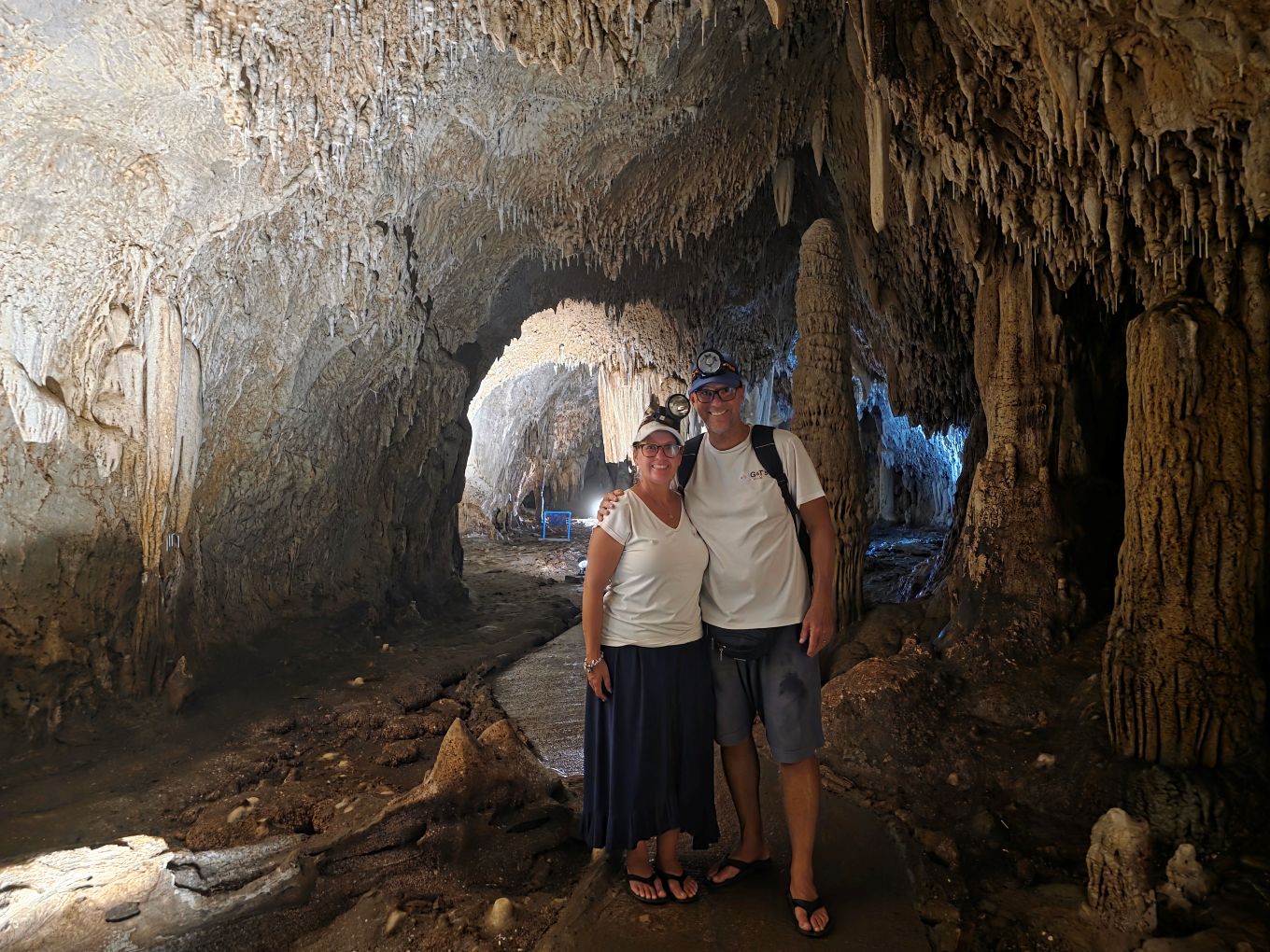
Thailand has an extraordinary ability to draw our attention towards the horizon.
Its islands, beaches and limestone cliffs dominate travel photographs. We look across turquoise water towards distant karsts, watch long-tail boats disappear between islands and inevitably find ourselves wondering what might be waiting around the next headland.
In Trang, one of our most memorable experiences required us to look in an entirely different direction.
Down.
At Khao Chang Hai Cave, there was no sweeping viewpoint waiting at the end and no tropical beach hidden beyond the darkness. Instead, armed with headlamps and accompanied by a local guide, we stepped beneath the limestone landscape and into a world that had been forming quietly beneath our feet for longer than we could properly comprehend.
For the next 30 to 40 minutes, Thailand disappeared above us.
And another version revealed itself below.
Beyond the Thailand We Imagined
By the time we reached Trang, we had already experienced some of southern Thailand's great coastal landscapes. Islands and limestone cliffs had become familiar companions, yet the geology responsible for much of that beauty was something we had mostly admired from the outside.
Khao Chang Hai changed that.
The experience was wonderfully uncomplicated. Tours operate at set times during the day, and for 200 baht per person we were provided with headlamps before following our guide into the cave.
There was something refreshing about its simplicity.
This wasn't an underground attraction transformed by elaborate lighting, paved pathways and carefully positioned displays. The darkness remained dark. The rock remained rock. Our headlamps illuminated only a small part of whatever happened to be immediately in front of us.
Within moments, the outside world disappeared.
The temperature changed. Sounds changed. Our field of vision contracted to whatever fell within a circle of light.
The landscape wasn't something we were looking at anymore.
We were inside it.
A Landscape Built in Darkness
Trang Province forms part of southern Thailand's remarkable limestone landscape, shaped over immense periods by water slowly dissolving and reshaping the rock.
Above ground, that process has helped create the cliffs and karst formations that define so much of the region. Underground, the same relationship between rock and water creates caves, chambers, passages, stalactites and stalagmites.
Knowing that intellectually is one thing.
Walking through the result is another.
Inside Khao Chang Hai, our headlamps picked out formations before surrendering them again to darkness as we moved forward. Some hung from the ceiling, others rose from the cave floor, while water and mineral deposits had created shapes that inevitably encouraged the imagination.
But perhaps the most impressive thing wasn't any individual formation.
It was the time required to create them.
A cave forces us to think on a scale human beings aren't particularly good at understanding. Water moves through limestone almost imperceptibly. Minerals accumulate gradually. Formations grow over periods vastly longer than a human lifetime.
Nothing here was in a hurry.
And yet the landscape had changed completely.
When Darkness Changes How We Travel
Most travel encourages us to see more.
We seek panoramic views, climb observation towers, visit lookouts and photograph landscapes stretching towards the horizon. Visibility is usually part of the reward.
Inside a cave, that relationship is reversed.
Our world shrinks.
A headlamp gives us only a few metres of certainty. Beyond that is darkness. Instead of constantly looking ahead towards a destination, attention moves towards the next step, the rock beside us, the ceiling above and the voice of the guide leading us forward.
It makes us more aware of where we are.
There is also something mildly unsettling about knowing that a substantial amount of rock sits between us and the sky. We rarely think about the ground beneath our feet when walking through a destination. It is simply the surface upon which everything else happens.
Khao Chang Hai reminded us that the surface is only part of the story.
Beneath roads, villages, forests and fields can exist landscapes completely invisible to the people moving above them.
Whole worlds can occupy the same place.
Thailand Beneath the Surface
That thought stayed with us because it also reflected something we were discovering about Thailand itself.
It is easy to arrive with a mental picture of the country already formed.
Bangkok. Temples. Street food. Tropical beaches. Long-tail boats. Phuket. Koh Samui. The famous islands of the Andaman Sea.
They are all part of Thailand, and many are extraordinary.
But travelling slowly has continually reminded us that the places between the famous destinations often reveal just as much.
Trang was one of those places.
We weren't surrounded by the intensity of Bangkok or the tourism infrastructure of Thailand's best-known islands. Experiences such as Khao Chang Hai felt quieter and more local, requiring relatively little beyond curiosity and a willingness to go somewhere we might once have travelled straight past.
That has become one of the unexpected pleasures of full-time travel.
When there is less pressure to race between headline destinations, the map begins to fill in.
The spaces between the places we recognise acquire names, stories and experiences of their own.
Sometimes we discover them above ground.
In Trang, we found one underneath it.
Coming Back Into The Light
Emerging from a cave is a surprisingly sensory experience.
After spending time in darkness, ordinary daylight suddenly feels excessive. Colours appear brighter. The warmth outside becomes more noticeable. The sky, which we barely thought about before entering, seems enormous.
Nothing outside has changed.
We have.
For less than an hour, our entire world had been reduced to limestone, darkness and the narrow beam of a headlamp. Then, almost instantly, everything opened again.
Perhaps that contrast is what makes caves so compelling.
We enter through a relatively small opening and temporarily leave behind the landscape we understand. There are no horizons underground. No distant mountains. No sunsets. Direction becomes less obvious and time feels strangely detached from whatever is happening outside.
Then we emerge into exactly the same place from which we began.
Except now we know something exists beneath it.
Final Reflection
Khao Chang Hai Cave will probably never be the reason most travellers come to Thailand.
Perhaps that is part of what we liked about it.
There are bigger attractions, more famous caves and certainly more photographed places. But travel doesn't always need to deliver something monumental to be memorable.
Sometimes it simply needs to show us something we hadn't thought to look for.
We arrived in Trang surrounded by a landscape we could see. Limestone mountains rose above the ground, vegetation covered the hills and roads carried us between towns and villages.
Khao Chang Hai revealed the other half of that landscape.
It reminded us that destinations, like people, are rarely understood entirely from the surface. There are layers beneath what first attracts our attention, and discovering them usually requires curiosity, time and occasionally the willingness to follow someone carrying a headlamp into the darkness.
Perhaps that is one of the greatest privileges slow travel has given us.
We have stopped asking only, “What are the famous things to see?”
Increasingly, we find ourselves wondering:
“What might we be missing?”
In Trang, the answer was beneath our feet.
With curiosity,
G&T
Find stories and insights that inspire your own path forward
Discover insights that elevate your travel, sharpen your leadership, and support your personal growth..

Join Our Adventure Today!
Stay updated with our latest travel stories, tips, and adventures. Join our newsletter!