
Malaysia Thailand Overland
Travel overland from Malaysia to Thailand, crossing Padang Besar by ferry, train and foot while discovering the rewards of slow travel
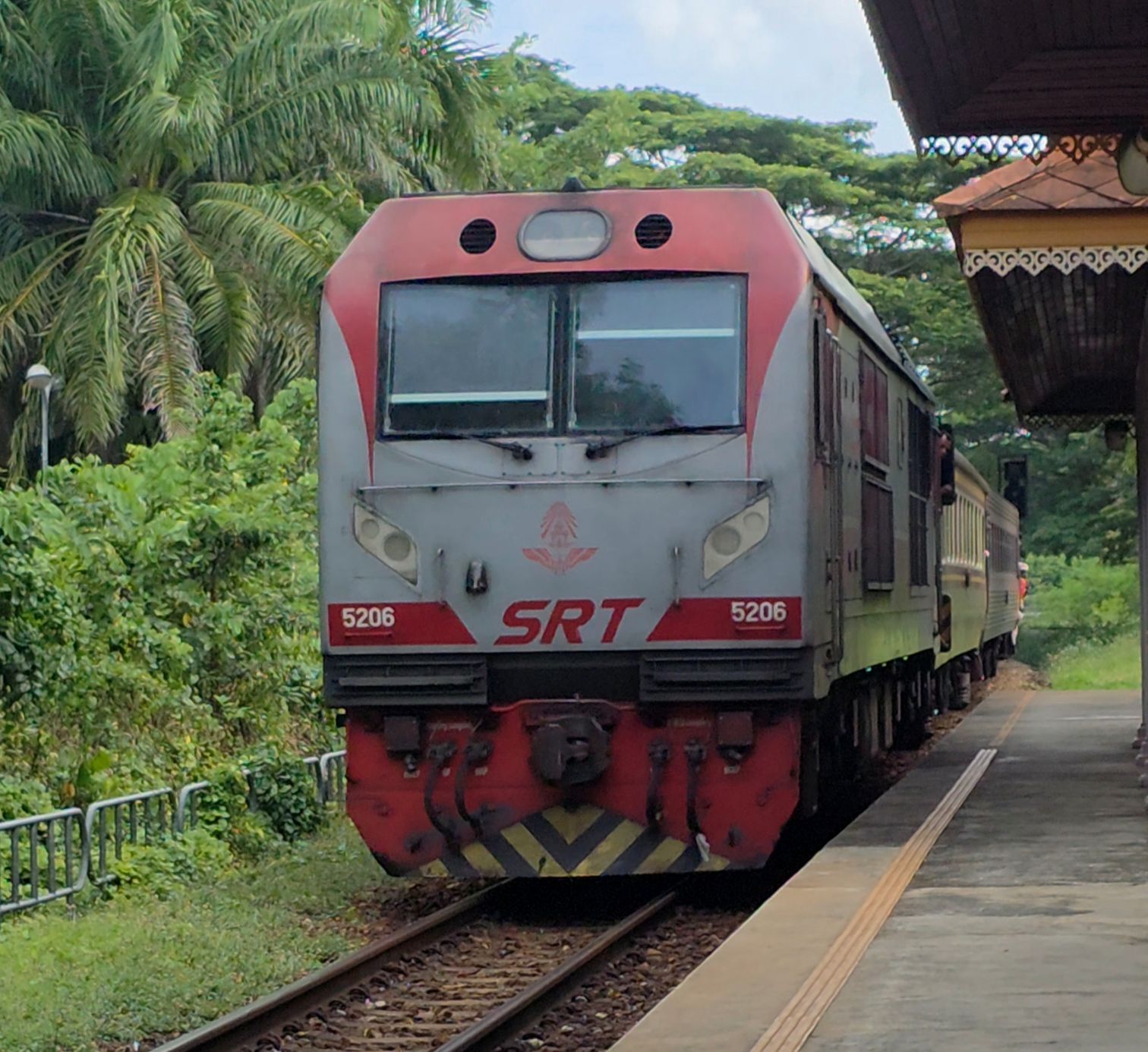
Airports are extraordinarily efficient at making the world smaller.
We can leave one country in the morning, spend a few hours inside terminals and aircraft, and emerge somewhere completely different. The language has changed, the currency has changed and perhaps even the time has changed, yet the transition itself has almost disappeared.
Since becoming full-time travellers, we have increasingly found ourselves drawn to the opposite.
Whenever practical, particularly within a country, we look for alternatives to flying. Trains, ferries, buses, scooters and our own feet allow us to experience the kilometres between destinations rather than simply removing them. It isn't always faster or easier, but when time is something we have deliberately given ourselves more of, efficiency no longer needs to make every decision.
Crossing from Malaysia into Thailand put that philosophy to the test.
We were leaving Langkawi after arriving for seven nights and staying for twenty-eight. Thailand was next, but rather than fly, we decided to travel by ferry, road and rail before eventually walking across the border at Padang Besar.
We weren't simply travelling from Malaysia to Thailand.
We were going to experience the space between them.
Leaving Slowly
Our journey began on Langkawi with a ferry across to Kuala Perlis on the Malaysian mainland.
There is something about leaving an island by boat that feels more definite than flying from it. Langkawi didn't suddenly disappear beneath an aircraft. We watched it recede as the ferry carried us towards the mainland.
From Kuala Perlis, we took a Grab to Arau Railway Station and bought tickets for the short KTM journey north to Padang Besar.
None of these individual stages was remarkable.
That was partly what made the journey interesting.
We weren't travelling through famous destinations. We were moving through the ordinary infrastructure that connects them: ferry terminals, roads, railway platforms and towns that exist whether travellers photograph them or not.
Slow travel gives us more opportunities to see this version of a country.
At Arau, we waited for the train with our backpacks beside us. There was no airport lounge and no international departure gate insulating us from our surroundings. We were simply passengers making our way north through Malaysia.
Then the train arrived.
Where One Country Becomes Another
Padang Besar is unusual because the border isn't something crossed thousands of metres above the ground.
We arrived in Malaysia.
We walked out of it.
After completing Malaysian immigration, we continued roughly 300 metres on foot towards Thailand. Somewhere within that short distance, one country ended and another began.
Borders are strange when we experience them this way.
On a map, they are precise lines. From an aircraft, they are almost meaningless. We can fly across several without ever knowing exactly when it happened.
Walking across one makes the idea suddenly tangible.
For a few minutes, we were between places. Malaysia was behind us, Thailand ahead, and everything we owned was travelling with us in our backpacks.
Then came Thai immigration.
Passports were checked, our arrival formalities completed and eventually we stepped outside.
We were in Thailand.
No baggage carousel announced it. No aircraft doors opened.
We had simply walked there.
When the Details Begin to Change
The differences between neighbouring countries aren't always dramatic at a land border.
That is precisely what makes crossing this way so interesting.
Change happens gradually.
The language on signs begins to shift. Currency changes from Malaysian ringgit to Thai baht. Food becomes subtly different. Railway systems change. Announcements sound unfamiliar. Even the design of stations, roads and buildings begins telling us we have moved somewhere new.
From Padang Besar, we boarded a Thai train towards Hat Yai.
It wasn't luxurious, and it didn't need to be.
The short journey carried us through southern Thailand while the landscape outside remained recognisably Southeast Asian. There was no cinematic moment when Malaysia vanished and Thailand suddenly appeared.
Instead, one place gradually became another.
That transition is something flying often removes.
Airports compress countries into departure and arrival. We leave through one terminal and emerge through another, with several hundred or several thousand kilometres reduced to the time between them.
Travelling overland restores some of that distance.
And with distance comes context.
The Value of Inefficiency
Slow travel is sometimes mistaken for travelling slowly simply for the sake of it.
For us, it means something slightly different.
It means having enough time to choose the journey rather than automatically choosing the fastest way to finish it.
Sometimes that means spending a week somewhere rather than two nights. Sometimes it means walking instead of taking a taxi. Sometimes it means a train journey where a flight would save several hours.
And occasionally it means turning a border crossing into an entire day.
Our journey from Langkawi into Thailand involved a ferry, car, train, walking and another train. A flight would undoubtedly have been simpler.
But simpler wasn't necessarily better.
The overland journey gave us something an airport couldn't.
It allowed us to feel ourselves leaving Malaysia.
After almost three months in the country, that mattered.
There was time to watch the landscape, hear the language around us one final time and experience those last ordinary pieces of Malaysian life before crossing into somewhere new.
Then Thailand arrived gradually rather than instantly.
The Places Between the Highlights
Travel naturally encourages us to focus on destinations.
Langkawi.
Hat Yai.
Bangkok.
Chiang Mai.
We place dots on maps and measure journeys according to how efficiently we can move between them.
But the map contains far more space between the dots than inside them.
Full-time travel has given us the privilege of paying more attention to that space.
Some of it is spectacular. Much of it isn't.
There are industrial outskirts, ordinary towns, railway sidings, highways, ferry terminals and stations where nothing particularly memorable happens.
Yet these places are part of understanding a country too.
Travel doesn't always need to produce a highlight.
Sometimes watching everyday life pass a train window is enough.
Sometimes sitting at a small railway station waiting for the next connection tells us something about a place that an airport never could.
And sometimes walking 300 metres between two immigration checkpoints becomes one of the clearest reminders that we really are travelling through the world rather than simply arriving in different parts of it.
Final Reflection
We don't avoid flying because we think there is something wrong with it. Sometimes geography, time or practicality makes flying the obvious choice, and we will happily take it.
But when there is another way, we increasingly find ourselves asking a different question.
Not simply, how quickly can we get there?
But, what might we experience if we don't?
Our journey from Langkawi to Thailand wasn't one of the spectacular experiences of our travels. There were no extraordinary temples, hidden lagoons or mountain views waiting along the way.
Instead, there was a ferry, a Grab, two trains, a railway platform, two immigration checkpoints and a short walk between countries.
And perhaps that ordinariness was the point.
For years, travel taught us to value destinations. Full-time travel is teaching us to value the distance between them.
Because when we stop treating every journey as something to get through, the space between where we were and where we are going begins to matter.
Sometimes the journey isn't what happens before the destination.
Sometimes it is part of the destination.
With time,
G&T
Find stories and insights that inspire your own path forward
Discover insights that elevate your travel, sharpen your leadership, and support your personal growth..

Join Our Adventure Today!
Stay updated with our latest travel stories, tips, and adventures. Join our newsletter!