
Angkor Wat Cambodia
Explore Angkor Wat, Cambodia, and Siem Reap's ancient temples, discovering breathtaking sunrises, Khmer Empire history and extraordinary cultural heritage firsthand
Angkor Wat: What remains of an empire.
Human beings have always been fascinated by the idea of leaving something behind.
We build cities, create monuments and devote enormous energy to achievements we hope will endure beyond our own lifetimes. Perhaps there is something deeply human about wanting to create something that will outlast us.
Almost a thousand years ago, the rulers of the Khmer Empire expressed that ambition on an extraordinary scale. They built Angkor, a vast network of temples, reservoirs and settlements that became the heart of one of Southeast Asia's most powerful civilisations.
Today, the ancient temples surrounding Siem Reap are among the world's greatest archaeological treasures. Their towering structures, intricate carvings and remarkable architecture offer a glimpse into a civilisation whose influence extended across much of the region.
We spent two days exploring ten temples, beginning with sunrise over Angkor Wat and finishing at Phnom Bakheng, where we hoped to watch the sun disappear over the surrounding landscape.
What we discovered was far more than an impressive collection of ancient buildings. Angkor tells a remarkable story about human ambition, religious devotion, the power of nature and the passage of time.
And perhaps most fascinatingly, it reveals what remains when an empire no longer exists.
Before the World Wakes
Our introduction to Angkor began at 4 am.
There is something slightly irrational about voluntarily leaving a comfortable bed at that hour, particularly when the day ahead involves considerable walking, climbing stairs and Cambodia's relentless heat. But some experiences are worth sacrificing a little sleep for.
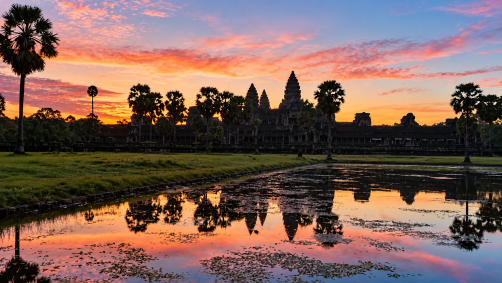
We joined other travellers beside the reflecting pools in front of Angkor Wat, waiting in darkness for the first signs of daylight. Gradually, deep blues softened into shades of orange and pink, while the temple's unmistakable towers emerged as silhouettes against the morning sky.
Their reflections appeared in the water below, creating one of those extraordinary scenes that photographs can capture but never quite reproduce.
For a while, we simply watched.
Yet understanding what stood before us would make the experience considerably more meaningful.
Constructed during the early twelfth century under King Suryavarman II, Angkor Wat was originally dedicated to the Hindu god Vishnu. Its design represents Mount Meru, the sacred mountain at the centre of Hindu cosmology, while its surrounding moat symbolises the cosmic ocean.
Over subsequent centuries, the temple became an important Buddhist religious site, reflecting the changing beliefs of the Khmer civilisation. Remarkably, it remains a place of religious significance today.
Nearly nine hundred years after its construction, the rulers who commissioned Angkor Wat are long gone, but their extraordinary creation continues to inspire millions.
Understanding the World Behind the Stones
One of our best decisions was exploring Angkor with a knowledgeable local guide.
Our small group consisted of approximately ten people, and our guide, Sam, brought the history of the Khmer Empire to life with remarkable enthusiasm, patience and knowledge.
Without his explanations, it would have been easy to spend two days admiring enormous stone structures without fully appreciating the civilisation responsible for creating them.
Angkor was never simply a collection of temples.
Between the ninth and fifteenth centuries, the region developed into the political and religious heart of the Khmer Empire. Its rulers oversaw an extensive network of settlements, roads, reservoirs and canals, supported by sophisticated water-management systems that helped sustain a substantial population.
The temples were expressions of religious belief, but also powerful statements of royal authority. Their construction demanded immense resources, skilled craftsmanship and engineering knowledge that remains impressive centuries later.
What fascinated us most was discovering how the temples reflected a civilisation continually evolving. Hinduism and Buddhism shaped different periods of Khmer history, while successive rulers built new monuments, adapted existing structures and expressed their beliefs through elaborate architecture and stone carvings.
As Sam explained these connections, we began seeing something beyond individual buildings. Each temple represented another chapter in a much larger story.
When Nature Reclaims an Empire
Of the ten temples we explored, Ta Prohm was unquestionably our favourite.
Many travellers recognise it from the film Lara Croft: Tomb Raider, but its Hollywood connection barely begins to explain what makes this place extraordinary.
Built during the late twelfth century under King Jayavarman VII, Ta Prohm was originally a Buddhist monastery. Today, it offers one of the most remarkable encounters between human architecture and the natural world that we have experienced during our travels.
Enormous tree roots descend across ancient walls, wrap themselves around doorways and weave between intricately carved stones. Some trees appear almost inseparable from the buildings beneath them, their roots gripping structures that have stood for centuries.
What struck us wasn't simply the power of nature, but the relationship between the two.
The buildings support the roots. The roots surround the buildings. Stone and vegetation have become so intertwined that separating them would fundamentally change the character of the place.
It doesn't feel like a simple story of nature defeating humanity. Instead, it feels like two different periods of history occupying the same space.
The Khmer builders created something extraordinary. Centuries later, nature began adding its own architecture.
Standing among those enormous roots and ancient stones, we found ourselves contemplating how temporary even humanity's greatest achievements can be.
Empires rise, monuments are built and generations devote their lives to creating something permanent. Eventually, the forest finds its way back.
A Thousand Years of History in Two Days
One of our initial concerns was whether visiting ten temples across two days might become repetitive.
How many ancient stone structures could we explore before they began to resemble one another?
As it turned out, quite a few.
Our second day took us through six temples spanning several centuries of Khmer history. At Preah Khan and Ta Som, both associated with twelfth-century Buddhist traditions, we explored corridors, courtyards and structures reflecting the religious ambitions of their time.
Neak Poan revealed another dimension of Khmer spiritual life, with its distinctive pools and central sanctuary demonstrating the symbolic importance of water.
Then the journey carried us further back into the Hindu period. East Mebon and Pre Rup, both tenth-century temples, revealed earlier architectural styles, their elevated structures offering a striking contrast to the temples we had already explored.
Our final destination was Phnom Bakheng, a ninth-century Hindu temple overlooking the surrounding Angkor landscape.
Across these six temples, we had effectively travelled backwards through centuries of changing religious beliefs, architectural traditions and royal ambitions.
What initially appeared to be a collection of ancient monuments gradually became a story of a civilisation continually reshaping itself.
It also reinforced why Angkor deserves more than a hurried visit to its most famous temple.
The Sunset That Never Came
Our journey finished at Phnom Bakheng, where we hoped to watch the sun disappear over the surrounding landscape.
Unfortunately, the weather had other ideas.
Clouds obscured the sunset, denying us the dramatic colours we had enjoyed at Angkor Wat on our first morning. But strangely, it didn't matter.
By then, we had spent two days exploring extraordinary historical sites, climbing countless stairs, walking through ancient corridors and admiring stone carvings created by craftspeople who lived centuries before us.
We had learned about kings, religions, architecture and the remarkable achievements of the Khmer Empire. More importantly, we had begun to understand the human stories behind the monuments.
The experience also reinforced the value of taking our time and travelling with someone who genuinely understands a destination's history.
Our small-group tour, comfortable transport and complimentary drinking water made the experience manageable, particularly in Cambodia's heat. But Sam's knowledge was what transformed it from sightseeing into something far more meaningful.
For anyone visiting Siem Reap, we would wholeheartedly recommend allowing at least two days, wearing comfortable footwear and exploring with a knowledgeable guide.
The missing sunset seemed a rather small disappointment.
Sometimes the most memorable part of travelling isn't the moment we planned to experience, but everything we discover along the way.
What Remains
When we stood beside the reflecting pools at Angkor Wat before sunrise, we were waiting for the light to reveal one of the world's most extraordinary temples.
Two days later, we understood that the stones were only part of the story.
The Khmer Empire had risen, flourished and eventually lost its position as a great political power. Religious traditions had evolved, rulers had come and gone, and forests had reclaimed buildings that once represented extraordinary wealth and influence.
Yet the temples remained, carrying fragments of the ambitions, beliefs and achievements of the people who created them.
Perhaps that is what makes Angkor so compelling.
It reminds us that nothing we build is entirely permanent, but that doesn't make the act of creating it any less meaningful.
The rulers who commissioned these monuments could never have imagined two Australian travellers wandering through them almost a thousand years later, trying to understand the world they inhabited.
Yet here we were, learning their stories from a Cambodian guide whose passion for his country's heritage made the experience unforgettable.
Perhaps that is the greatest legacy any civilisation can leave behind. Not simply monuments that endure, but stories that continue to inspire curiosity, understanding and wonder long after the people responsible for creating them are gone.
Nearly nine hundred years after its construction, the morning sun still rises behind Angkor Wat.
The empire that built it is gone, but its legacy remains woven into Cambodia's identity.
And its story is still being told.
With wonder,
G&T
Find stories and insights that inspire your own path forward
Discover insights that elevate your travel, sharpen your leadership, and support your personal growth..
Join Our Adventure Today!
Stay updated with our latest travel stories, tips, and adventures. Join our newsletter!