
Bangkok's Royal Barge Procession
Discover Bangkok’s Royal Barge Procession, a centuries-old Thai tradition bringing spectacular ceremonial barges, royal history and Buddhist culture to life
Some of the most memorable moments in travel are the ones we never went looking for.
They aren't saved on an itinerary or anticipated for months before we arrive. Sometimes we simply find ourselves in the right place at the right time, watching something we barely understand, only to discover later how fortunate we were to witness it.
That happened to us in Bangkok.
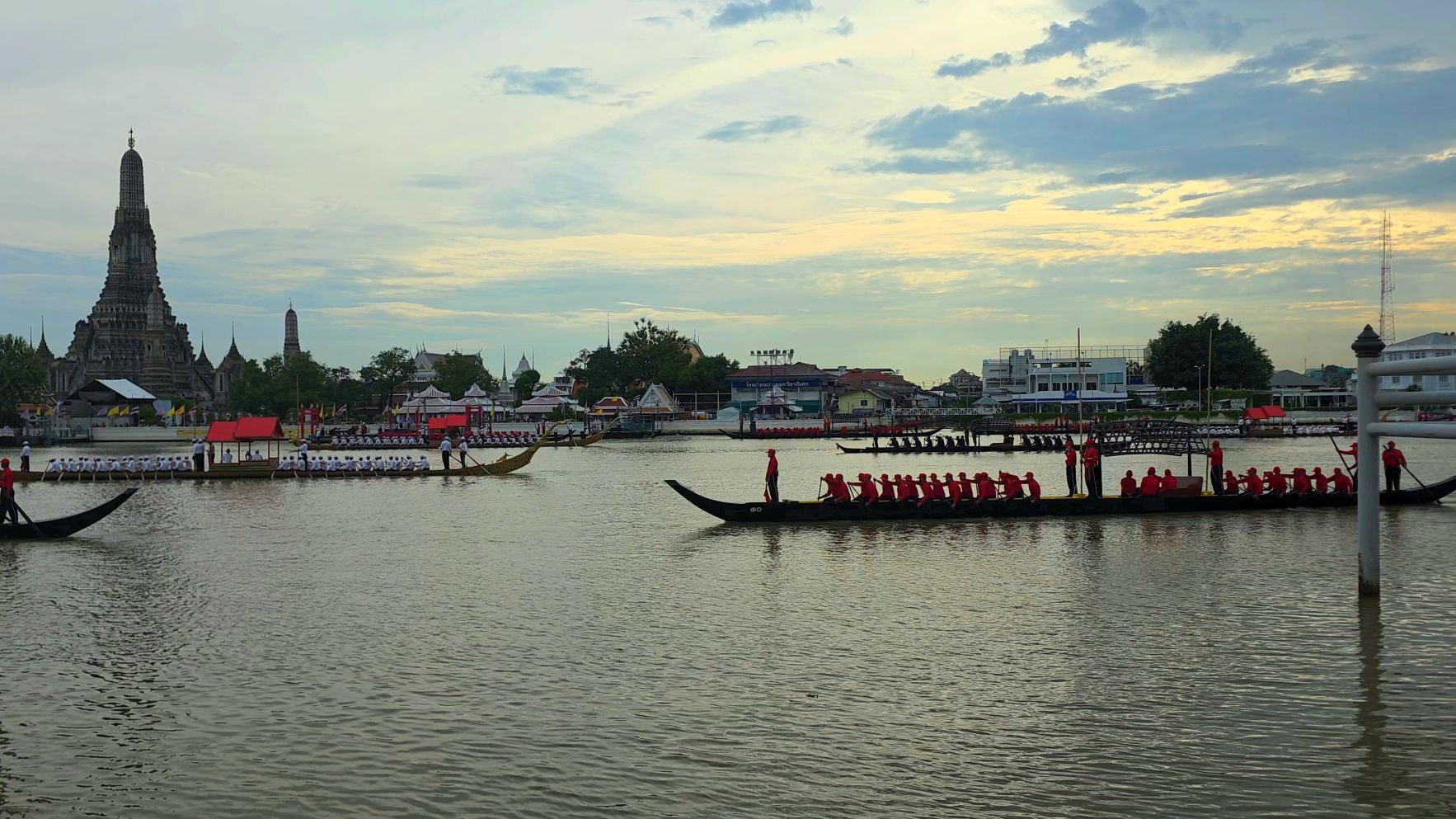
We had been travelling through Thailand for weeks when we learned that a rehearsal for the Royal Barge Procession would take place on the Chao Phraya River. We knew very little about it and certainly hadn't come to Bangkok to see it. But curiosity took us to Tha Tien Pier, where we found a position overlooking the river with Wat Arun rising magnificently on the opposite bank.
Then the barges appeared.
Long, elaborately decorated vessels moved along the river, powered by rows of oarsmen working in remarkable unison. Against the backdrop of one of Bangkok's most recognisable temples, the procession seemed almost disconnected from the modern city surrounding it.
We had stumbled across something extraordinary.
A Tradition on the River
The Chao Phraya has always been more than a river running through Bangkok. Long before expressways, railways and skyscrapers transformed the city, waterways were central to transport, commerce and daily life. They were also places of ceremony.
Thailand's tradition of royal ceremonial barges can be traced back centuries, developing significantly during the Ayutthaya period when elaborate vessels were used for royal journeys and religious occasions. The barges eventually became extraordinary expressions of Thai craftsmanship, decorated with gilding, intricate carvings and figures drawn from Buddhist and Hindu mythology.
The tradition was disrupted during the twentieth century, particularly around the Second World War, when some of the historic vessels were damaged. Restoration followed, and in 1957 the Royal Barge Procession returned as part of celebrations marking the 25th Buddhist Century.
That history completely changed the way we viewed what was happening in front of us. We weren't watching a historical performance created for tourists. We were witnessing a centuries-old tradition that had survived war, political change and the transformation of Bangkok into one of Asia's great modern cities.
When the Past Meets the Present
The 2026 procession is being prepared for the Royal Kathin Ceremony at Wat Arun on 6 November, connected with celebrations marking Queen Suthida's 48th birthday anniversary. The full procession is planned to involve 52 royal barges and approximately 2,200 Royal Thai Navy personnel, arranged in five columns stretching more than a kilometre along the Chao Phraya.
We were seeing only a rehearsal, yet even that was impressive.
Perhaps what fascinated us most was the setting. Bangkok makes its modernity impossible to miss. Trains run above crowded roads, enormous shopping centres fill entire city blocks and towers continue reshaping the skyline. Yet here, in the middle of all that progress, an ancient ceremonial tradition was moving slowly along the river.
For a while, two versions of Thailand occupied the same space.
Neither diminished the other. Modern Bangkok continued around us while the barges passed Wat Arun exactly because Thailand had chosen to preserve something from its past.
There was something powerful about that.
The Things We Don't Know to Look For
Modern travel allows us to research almost everything before we arrive. We know which attractions to visit, where to eat and even where to stand for the photograph we've already seen hundreds of times online.
It makes travelling easier, but it can also make discovery surprisingly difficult.
The Royal Barge Procession reminded us of the value of occasionally not knowing what comes next.
Had we remained entirely within the Bangkok we had planned, we might never have learned about this tradition. Instead, one unexpected afternoon beside the Chao Phraya became a lesson in Thai history, Buddhism, monarchy, craftsmanship and the relationship between Bangkok and its river.
That is something we increasingly appreciate about full-time travel. The longer we travel, the more aware we become of how much we don't know.
Every country contains traditions, histories and stories that may never appear on our original itinerary. We can pass them without understanding them, or we can become curious enough to ask why they matter.
Sometimes that question changes an experience completely.
Final Reflection
We arrived at Tha Tien Pier knowing very little about what we were about to witness. Perhaps that was part of what made it so memorable.
There had been no bucket list and no months of anticipation. We simply stood beside the Chao Phraya and watched these extraordinary barges pass in front of Wat Arun. Then we wanted to understand what we had seen.
In doing so, we discovered another layer of Thailand.
Travel is often described as discovering the world, but perhaps some of its greatest value comes from discovering how much of the world we never knew existed. That requires occasionally stepping outside the routine, following something we hadn't planned and remaining curious enough to understand it when we find it.
We didn't come to Bangkok looking for the Royal Barge Procession.
Perhaps that is exactly why finding it meant so much.
With awareness,
G&T
Find stories and insights that inspire your own path forward
Discover insights that elevate your travel, sharpen your leadership, and support your personal growth..

Join Our Adventure Today!
Stay updated with our latest travel stories, tips, and adventures. Join our newsletter!