
Cambodia Killing Fields
Explore Cambodia's Killing Fields at Choeung Ek, Phnom Penh, uncovering Khmer Rouge atrocities, powerful memorials, historical lessons and enduring hope
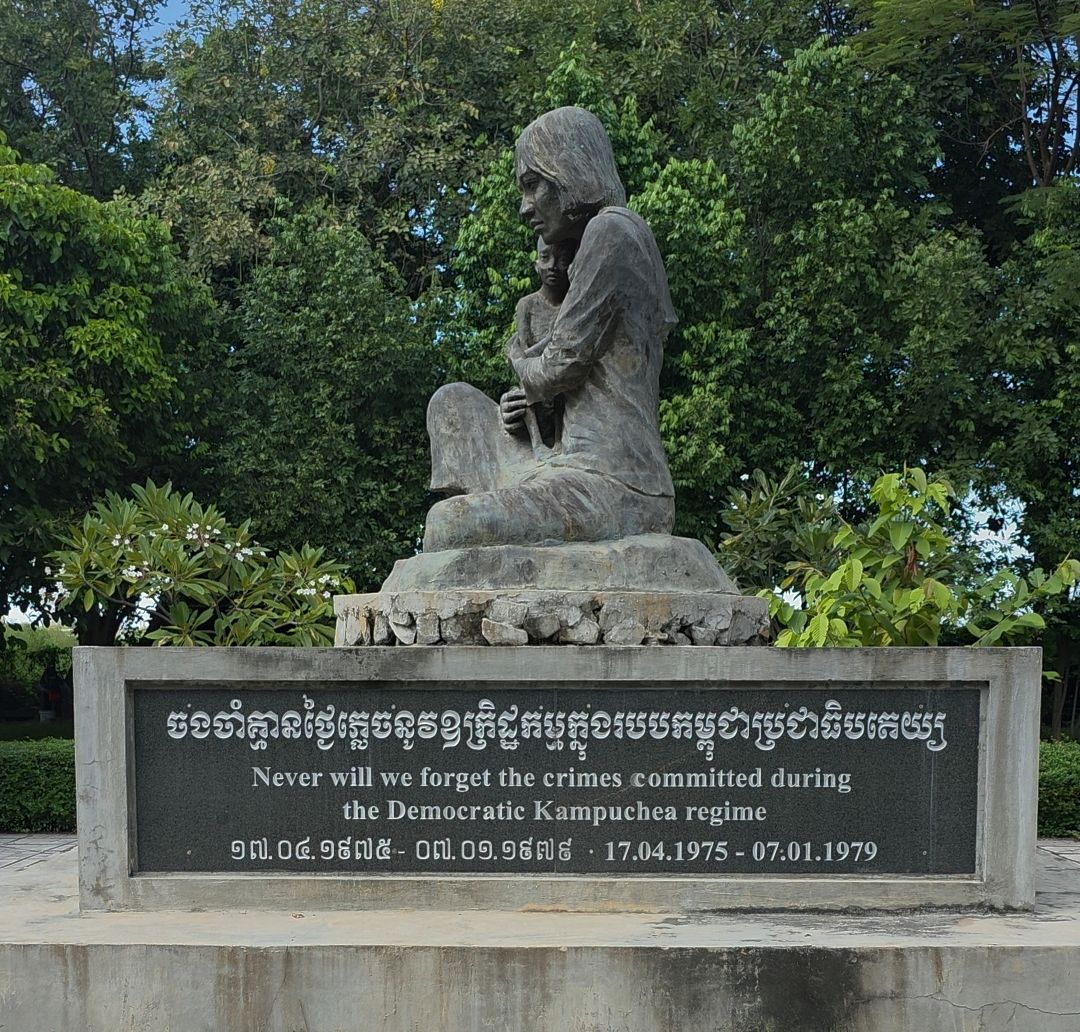
There is something deeply unsettling about standing in a peaceful place and knowing that the ground beneath your feet holds evidence of unimaginable human suffering.
At Choeung Ek, commonly known as the Killing Fields, on the outskirts of Phnom Penh, the surrounding greenery and quiet atmosphere seem almost impossible to reconcile with the atrocities committed here during Cambodia's Khmer Rouge era.
We had already visited the Tuol Sleng Genocide Museum, better known as S-21, where thousands of people were imprisoned, interrogated and tortured. That experience had been confronting, but visiting Choeung Ek brought another dimension to our understanding of Cambodia's tragic history.
S-21 revealed the machinery of persecution. The Killing Fields revealed its devastating consequences.
Together, these visits became among the most meaningful experiences of our time in Cambodia, challenging us to reflect on the fragility of human rights, the consequences of unchecked power and the importance of remembering those whose lives were taken.
A Peaceful Place with a Terrible Past
When the Khmer Rouge seized control of Cambodia in April 1975, its leadership, under Pol Pot, began implementing a radical vision of an agricultural society.
Cities were forcibly emptied, families separated and millions of Cambodians sent to rural labour collectives. Education, religion and traditional institutions were systematically dismantled, while anyone suspected of opposing the regime faced persecution.
Between 1975 and 1979, an estimated 1.5 to 2 million people died through executions, starvation, disease and forced labour, approximately a quarter of Cambodia's population.
Choeung Ek, once an orchard and cemetery, became one of the principal execution sites associated with S-21.
Prisoners who had endured interrogation and torture were transported here, often at night, where they were murdered and buried in mass graves.
Following the Khmer Rouge's fall in January 1979, excavations uncovered the remains of thousands of victims, exposing the systematic nature of the killings.
Walking through Choeung Ek today, the contrast between its peaceful appearance and its history is difficult to comprehend. The landscape has changed, but the significance of what occurred here remains impossible to ignore.
When the Ground Holds the Evidence
Unlike S-21, where photographs, documents and former prison cells reveal the experiences of those detained, Choeung Ek tells much of its story through the landscape itself.
Depressions in the earth mark the locations of mass graves, while memorial signs explain the significance of different areas.
The preserved grounds provide a confronting understanding of the scale and deliberate organisation of the killings, without requiring elaborate displays or dramatic interpretation.
Perhaps the most striking feature is the memorial stupa, a Buddhist monument containing thousands of human skulls recovered from the site.
Standing before it, we were reminded that these were not simply victims of a historical event. They were individuals with families, relationships, hopes and futures that were taken from them.
Statistics help us understand the scale of tragedy, but they can never fully communicate the human cost.
What affected us most was the knowledge that so many ordinary lives had been destroyed by a system in which suspicion, fear and obedience to authority had replaced compassion and respect for human dignity.
Choeung Ek is not somewhere to approach as an ordinary tourist attraction. It is a place of mourning and remembrance, where the responsibility of visitors is to listen, reflect and acknowledge the suffering of those who died.
A Tragedy Beyond Choeung Ek
Although Choeung Ek is Cambodia's best-known Killing Fields memorial, it represents only one part of the suffering experienced throughout the country.
Thousands of mass graves and former detention sites have been documented across Cambodia, reflecting the extraordinary reach of the Khmer Rouge's system of repression.
The victims were not only those executed. Countless others died through starvation, disease, exhaustion and the destruction of everyday social and economic life.
The consequences extended far beyond the regime's collapse.
Families had lost parents, children and relatives. Communities had been fractured, educational institutions disrupted and generations deprived of opportunities that many of us consider fundamental to a secure and fulfilling life.
Cambodia's recovery has required rebuilding institutions, restoring communities and confronting a painful history that remains within living memory.
Visiting both S-21 and Choeung Ek helped us understand why preserving these places matters.
They reveal different stages of the same system, from imprisonment and forced confessions to execution, while reminding future generations of the consequences when authority operates without accountability.
Yet they also represent something more important than the preservation of physical evidence.
They ensure that the people who suffered are not reduced to statistics or forgotten as history moves forward.
The Responsibility of Remembering
One of the greatest privileges of travelling is the opportunity to encounter histories and perspectives that challenge our understanding of the world.
Some experiences inspire us through human achievement. Others force us to confront humanity's capacity for cruelty.
Our visits to S-21 and the Killing Fields belonged firmly in the latter category, yet we were genuinely grateful for the opportunity to learn.
As Australians, we have been fortunate to enjoy freedoms, security and opportunities that are not universally shared. Standing at Choeung Ek reminded us how easily those conditions can be taken for granted.
It also encouraged us to reflect on the challenges facing the world today.
Conflict, persecution, political division and human rights abuses continue to affect communities across the globe. While contemporary circumstances should not be casually compared with Cambodia's genocide, the importance of protecting human dignity, independent institutions and accountability remains as relevant as ever.
History demonstrates that atrocities do not emerge in isolation. Dehumanisation, fear, repression and the concentration of unchecked power can create conditions in which increasingly extreme abuses become possible.
Remembering the past cannot guarantee that humanity will avoid repeating its mistakes, but understanding how such events occurred gives future generations a better opportunity to recognise the dangers.
Perhaps the greatest responsibility of remembrance is not simply knowing what happened, but considering what we are prepared to do to prevent similar suffering.
From a Place of Death to a Place of Hope
Despite the sadness associated with Choeung Ek, we left with a sense of hope.
Not because the suffering can ever be undone, but because Cambodia has preserved this difficult history and created opportunities for future generations to learn from it.
In July 2025, Choeung Ek, Tuol Sleng and the former M-13 prison were collectively inscribed on the UNESCO World Heritage List as Cambodian Memorial Sites, recognising their importance as places of remembrance, education and reflection.
There is something profoundly meaningful about transforming places once associated with fear and death into memorials dedicated to preserving truth and encouraging peace.
The Khmer Rouge sought to erase lives, identities and histories. Today, these memorials stand as a deliberate refusal to allow those lives to disappear from collective memory.
We would strongly encourage travellers visiting Phnom Penh to experience both S-21 and the Killing Fields. Neither is easy, and both deserve to be approached with sensitivity and respect, but together they offer an essential understanding of Cambodia's recent history.
For us, these visits also deepened our appreciation of the Cambodia we have come to know, a country whose people have endured extraordinary suffering while continuing to rebuild their communities, preserve their culture and shape their future.
We left Choeung Ek saddened by what had occurred, grateful for the opportunity to learn and hopeful that the lessons preserved here will continue to reach generations yet to come.
We cannot restore the lives lost at Choeung Ek, but we can ensure their stories are not forgotten. And perhaps the greatest tribute we can offer those who suffered is to carry the lessons of their history into the choices we make today.
With remembrance and hope,
G&T
Find stories and insights that inspire your own path forward
Discover insights that elevate your travel, sharpen your leadership, and support your personal growth..
Join Our Adventure Today!
Stay updated with our latest travel stories, tips, and adventures. Join our newsletter!