
Tana Toraja Traditions
Discover Tana Toraja, South Sulawesi, Indonesia, where ancient funeral traditions, cliff burials and ancestral beliefs reveal a remarkable cultural relationship with death
There are places we visit that show us landscapes we have never seen before. Others introduce us to food, architecture or traditions entirely unfamiliar to us. And occasionally, travel places us in front of something more confronting: a way of understanding life that challenges assumptions we have rarely thought to question.
Tana Toraja did that for us.
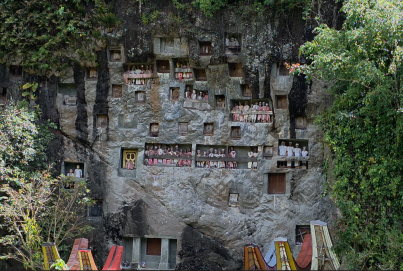
High in the mountains of South Sulawesi, the Torajan relationship with death is woven deeply into family, community and tradition. Funerals can be elaborate communal events. Graves are carved into cliffs and rock faces. Effigies of the deceased can look out across the landscape. In some traditional practices, a person who has died may remain within the family home for an extended period before their funeral takes place.
To Western eyes, much of this can initially seem confronting. Death, after all, is something many of us have learned to keep at a distance.
In Tana Toraja, we began to understand that distance isn't universal.
Where Death Remains Part of Life
Travelling through Toraja is visually extraordinary. Mountains and rice terraces surround villages dominated by the unmistakable curved roofs of traditional tongkonan houses. Buffalo graze beside fields, motorbikes wind through narrow roads and everyday life continues against a landscape that feels both beautiful and deeply connected to the past.
But it is impossible to understand Toraja simply by admiring its scenery.
Death is present here in ways we weren't accustomed to seeing. Burial sites occupy cliffs and caves. Wooden figures known as tau tau represent some of those who have died. Family tombs remain places of connection rather than monuments separated entirely from everyday life.
Underlying many of these traditions is Aluk To Dolo, the ancestral belief system of the Torajan people. Christianity later became dominant across the region, yet older customs surrounding death, ancestry and ceremony continued, creating a cultural landscape in which different beliefs have become intertwined.
What initially appears to an outsider as an extraordinary preoccupation with death begins to look different once we spend time trying to understand it.
Perhaps Toraja isn't unusually focused on death.
Perhaps many of us are unusually determined to hide it.
A Funeral That Isn't Simply Goodbye
The Torajan funeral tradition is perhaps the clearest example.
We were fortunate to witness part of this culture firsthand, and it quickly became apparent that describing these ceremonies simply as funerals misses much of their meaning. They are gatherings of extended families and communities, expressions of obligation and respect, and important moments in the relationship between the living and those who have died.
In traditional Torajan belief, death is not necessarily treated as an immediate departure. Until the appropriate funeral rites take place, the deceased may continue to be regarded as part of the household, sometimes described as being ill or sleeping rather than completely gone.
For someone raised within a very different understanding of death, that can be difficult to comprehend at first.
Our instinct is often to ask why.
Why keep someone who has died within the home? Why devote so much time and expense to a funeral? Why maintain such a visible relationship with ancestors?
But travel is at its most valuable when we resist the temptation to judge another culture according to the rules of our own.
The better question became: what does this mean to the people who live here?
And once we began asking that, Toraja started revealing something much deeper.
The Weight of Ceremony
Torajan funerals can involve large gatherings lasting several days, with family members travelling considerable distances to attend. Buffalo and pigs traditionally play an important ceremonial role, and the scale of proceedings can reflect family relationships, social standing and obligations accumulated across generations.
From outside the culture, these elements can easily become the spectacle. Images of animal sacrifice and elaborate ceremonies are often what attract attention.
But concentrating only on what appears unfamiliar risks missing what is familiar underneath it.
Families gather.
Food is prepared and shared.
Stories are remembered.
Responsibilities are honoured.
People travel home because someone's life mattered.
During our time in Toraja, we experienced Pa’piong, a traditional method of cooking food inside bamboo. It was another reminder that ceremony here is not detached from ordinary communal life. Food, family, hospitality and tradition sit alongside mourning rather than being separated from it.
The details may be profoundly different from the customs we grew up with, but the human need beneath them isn't difficult to recognise.
We want the people we love to matter after they are gone.
Toraja simply expresses that idea in a language very different from ours.
A Landscape of Memory
Perhaps nowhere is that relationship more visible than in Toraja's burial traditions.
Across the region, graves can be carved directly into limestone cliffs or placed within caves and rock faces. In some locations, tau tau stand above them, facing outward from balconies cut into the stone.
There is something powerful about seeing generations physically embedded within the landscape.
In many Western communities, cemeteries tend to exist apart from the places where daily life unfolds. We visit them deliberately, often briefly, before returning to a world in which death is largely absent from view.
Toraja doesn't always offer that separation.
The dead remain part of the physical landscape inhabited by the living. Ancestors remain connected to families. Memory has a place.
That doesn't mean grief is somehow easier here, nor would we pretend to understand the emotional complexity of traditions developed over centuries after spending only a short time among them.
But it did make us question something about our own culture.
In trying so hard to remove death from everyday life, have we also made it more frightening when it inevitably arrives?
When Our Version of Normal Isn't Universal
One of the great privileges of travelling slowly is having our definition of normal challenged repeatedly.
We cross a border and language changes. Religion changes. Food changes. Ideas about family, community, success and happiness change.
Then occasionally we encounter somewhere like Tana Toraja, where even our assumptions about the boundary between life and death are challenged.
Travel doesn't always need to change what we believe. Sometimes its value lies simply in showing us that what feels completely normal to us isn't universal.
We left Toraja without suddenly adopting its beliefs about death. That was never the point.
What changed was our willingness to question our own.
Perhaps there isn't one correct amount of time to mourn. Perhaps remembering someone doesn't require eventually placing them neatly into the past. Perhaps maintaining a relationship with those who came before us isn't something that needs to be explained away.
Different cultures have spent thousands of years answering the same unavoidable human question in remarkably different ways:
What do we do when someone we love dies?
Toraja's answer is complicated, communal and deeply rooted in place.
Final Reflection
Before visiting Tana Toraja, we knew its funeral traditions were famous. We expected them to be interesting, perhaps confronting, and unlike anything we had experienced before.
What we didn't expect was how much they would make us think about our own relationship with death.
It would have been easy to leave with photographs of cliff graves, tongkonan houses, buffalo and tau tau and describe Toraja as one of Indonesia's most unusual destinations. But doing so would reduce something deeply meaningful to the people who live there into little more than a travel curiosity.
What stayed with us wasn't how differently Torajans treat death.
It was how recognisable the reasons behind those traditions eventually became.
Family matters. Memory matters. Belonging matters. The people who shaped our lives continue to shape us after they are gone.
Perhaps the rituals we use to express those things are less important than our willingness to acknowledge them.
We arrived in Tana Toraja thinking we were visiting a culture with an extraordinary relationship with death. We left wondering whether it might actually have an extraordinary relationship with remembrance.
And perhaps that is what travel does at its best. It takes something we thought we understood, turns it around, and quietly asks us to look again.
With remembrance,
G&T
Find stories and insights that inspire your own path forward
Discover insights that elevate your travel, sharpen your leadership, and support your personal growth..

Join Our Adventure Today!
Stay updated with our latest travel stories, tips, and adventures. Join our newsletter!