
Tiger Cave Temple
Discover Tiger Cave Temple Krabi, Thailand, where 1,260 challenging steps lead to a spectacular Buddhist temple and breathtaking panoramic views
Travel has become remarkably good at removing effort.
Cable cars carry us to mountain summits. Boats deliver us to isolated beaches. Escalators move us through airports before trains, buses and taxis deposit us almost exactly where we want to be. We can cross countries in hours and arrive at extraordinary viewpoints without doing much more than buying a ticket.
There is nothing wrong with that. Accessibility allows more of us to experience places that previous generations could only imagine.
But occasionally we encounter somewhere that refuses to make things quite so easy.
Tiger Cave Temple in Krabi is one of those places.
At the base of the mountain, the proposition seems straightforward enough. Somewhere above us sits one of southern Thailand's most spectacular Buddhist sites, with a golden Buddha overlooking the limestone landscape of Krabi.
Between us and it were 1,260 steps.
Not ordinary steps either.
Some were shallow. Others seemed designed for people with considerably longer legs than ours. The staircase climbed relentlessly upwards through tropical heat and humidity, occasionally offering glimpses through the trees of just how far we had already come.
We knew there was a remarkable view waiting at the top.
What we didn't yet understand was how much the climb would change the way we saw it.
Beneath the Mountain
Tiger Cave Temple, or Wat Tham Suea, sits among the limestone formations that make Krabi such a distinctive part of southern Thailand.
The temple was established in the 1970s after the Buddhist monk Ajahn Jumnean Seelasettho came to the area to meditate. Local tradition associates the cave with tigers, with stories describing either tigers living within the cave or paw-like impressions in the rock giving the temple its name.
Today it is an active Buddhist temple and meditation centre rather than simply another Krabi attraction.
That distinction matters.
Visitors may arrive because of the staircase and the famous summit view, but the mountain has a spiritual significance that predates its popularity on social media. Buddhist monks came here seeking isolation, meditation and contemplation.
Long before travellers began climbing the mountain for photographs, people were coming here for something much less visible.
Perhaps that makes the effort required to reach the summit particularly appropriate.
There is no shortcut.
The mountain asks us to slow down.
Step One
Every difficult climb begins with a period of completely unjustified confidence.
The first steps weren't particularly intimidating.
We had water. We were reasonably prepared. We knew other people climbed it every day.
How difficult could 1,260 steps really be?
The answer began revealing itself surprisingly quickly.
Krabi's tropical heat doesn't disappear because we have decided to exercise. The humidity wraps around us, and within a relatively short distance the staircase begins demanding our attention.
Conversation becomes shorter.
Breathing becomes louder.
The summit becomes considerably more theoretical.
There is something psychologically deceptive about stairs. Walking 1,260 steps across flat ground would barely register. Put those same steps almost continuously upwards and suddenly every one of them seems to have a personality.
Some were almost polite.
Others were ridiculous.
We climbed.
Stopped.
Drank water.
Climbed again.
The numbers marking our progress became increasingly important.
And increasingly irritating.
When the Summit Feels Further Away
Somewhere around step 900, something strange happened.
We had climbed hundreds of steps. Logically, we knew we were getting close.
It didn't feel like it.
Looking upwards, there were still stairs disappearing above us.
By then the excitement of beginning had long disappeared. The body had taken over the conversation.
Legs were tired.
Clothes were damp.
Breathing had become something we were very aware of.
And the obvious question appeared.
Why are we doing this?
It is a question that tends to arrive during any voluntary physical challenge.
Nobody was making us climb the mountain.
We could turn around.
The temple would still be there.
Krabi would still be beautiful from below.
We already had photographs.
Stopping would have been entirely reasonable.
But once we had climbed that far, turning around somehow felt harder than continuing.
So we kept moving upwards.
One step.
Then another.
There was no profound revelation.
No sudden burst of energy.
Just the quiet decision to continue.
The View We Earn
Eventually, the staircase ended.
And the world opened.
From the summit, Krabi seemed to stretch forever.
Limestone mountains rose unexpectedly from an enormous green landscape. Roads became thin lines. Buildings became insignificant. In the distance, the land eventually surrendered to the Andaman Sea.
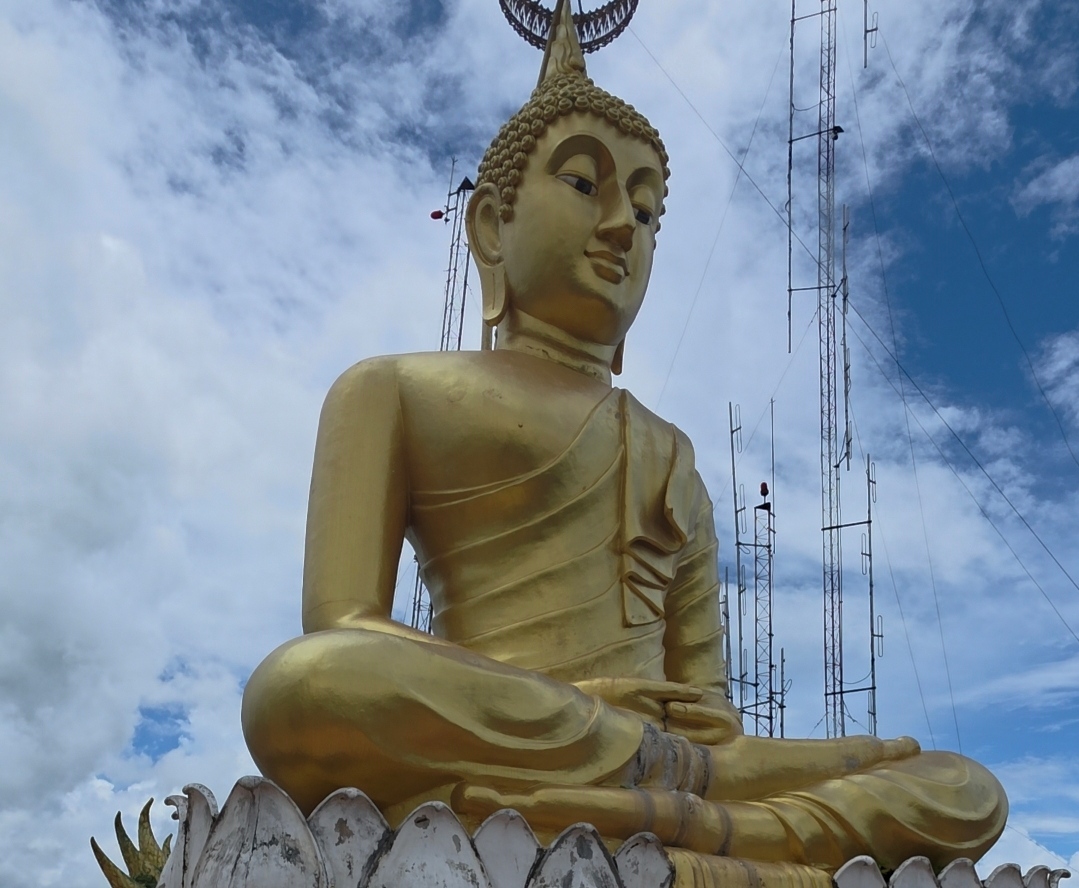
Above it all sat the enormous golden Buddha, serene and unmoved by the exhausted travellers arriving beside it.
We had seen photographs of this view before climbing.
They hadn't prepared us for it.
But perhaps photographs never could.
Not because the scenery was impossible to capture, although it was spectacular.
Because the photograph couldn't capture the previous 1,260 steps.
It couldn't capture the heat.
The sweat.
The stops for water.
The moments when we looked upwards and wondered how much further there could possibly be.
The view hadn't changed because we climbed to reach it.
We had.
And that changed the value of what we were looking at.
When Effort Changes Reward
Travel constantly gives us extraordinary things with surprisingly little effort.
We can watch sunrise from a famous viewpoint after being driven almost to the top. We can step from an air-conditioned vehicle onto a beach people once needed boats and considerable determination to reach. We can fly across oceans overnight and wake up on another continent.
Convenience has transformed travel.
Mostly for the better.
But convenience can also change our relationship with anticipation.
When something arrives easily, we can consume it quickly.
Photograph it.
Admire it.
Move on.
Tiger Cave Temple doesn't allow that quite so readily.
The mountain creates anticipation one step at a time.
Every hundred steps increases our investment in reaching the top. Every pause reminds us that the destination still requires something from us.
By the time we arrive, the summit isn't simply another attraction.
It has become the conclusion of a journey.
The effort has given the view context.
Perhaps that is why experiences we work for often remain with us longer than experiences handed to us effortlessly.
The reward may be identical.
Our relationship with it isn't.
More Than a Viewpoint
It would be easy to reduce Tiger Cave Temple to its staircase.
Most conversations about visiting eventually arrive at the same question.
How difficult is the climb?
The honest answer is that it is challenging.
The heat matters. Fitness matters. The unusually steep sections matter. Taking enough water matters. And there is no prize for reaching the summit quickly.
But focusing entirely on the physical challenge risks missing where we actually are.
This is a Buddhist temple.
People come here to worship, meditate and reflect. The golden Buddha at the summit isn't decoration for a viewpoint. The shrines aren't props for photographs.
As visitors, we are entering a religious space that happens to occupy an extraordinary landscape.
There is something about that combination that changes the atmosphere at the top.
People arrive exhausted and become quieter.
Some sit.
Some pray.
Others simply look.
After more than a thousand steps of concentrating on our own bodies, the summit encourages us to lift our eyes again.
The landscape does the rest.
The Journey Down
There is, of course, one small flaw in the emotional satisfaction of reaching the summit.
We still have to get back down.
Descending 1,260 steep steps introduces an entirely different conversation between knees and gravity.
Yet going down also provides something climbing rarely does.
Perspective.
Places where we had stopped exhausted on the way up passed more quickly. Numbers that had seemed impossibly far apart suddenly disappeared beneath us.
We could see the progress that had been difficult to recognise while making it.
Perhaps effort often works that way.
While we are inside something difficult, progress can feel painfully slow.
Looking backwards, the distance becomes obvious.
Eventually we reached the bottom.
The mountain returned to towering above us.
The summit that had consumed so much of our attention disappeared again into the landscape.
But it no longer looked quite the same.
We knew what was up there.
More importantly, we knew what it had taken us to see it.
What Difficulty Adds
We don't believe travel needs to be difficult to be meaningful.
Comfort isn't something that needs apologising for. Neither is convenience.
Some of our favourite experiences have required almost no physical effort at all.
But Tiger Cave Temple reminded us that difficulty can sometimes add something that convenience cannot.
Investment.
When we give something our time, energy or determination, we become more connected to the outcome.
The principle extends far beyond climbing mountains.
Sometimes the meal tastes better because we waited.
The hidden beach feels more beautiful because reaching it required a journey.
The wildlife encounter means more because we spent hours quietly searching rather than being guaranteed a sighting.
And sometimes a view stays with us because our legs remember exactly what was required to reach it.
Effort doesn't automatically make an experience worthwhile.
But when something extraordinary is waiting at the other end, effort can make us appreciate it differently.
Final Reflection
At the bottom of Tiger Cave Temple, the summit was simply somewhere we wanted to reach.
At the top, it became something else.
The view across Krabi was spectacular, but spectacular views are not difficult to find in this part of Thailand. We had already seen limestone cliffs, tropical islands, beaches and mountains that would compete with almost anywhere we had travelled.
What made this one different was the journey between looking upwards from the first step and finally looking down from the summit.
There were 1,260 reasons to turn around.
There only needed to be one reason to continue.
We wanted to know what was waiting at the top.
Travel increasingly allows us to remove the difficult parts of getting somewhere. Most of the time, we're grateful for that.
But every so often, a place still asks something from us.
Tiger Cave Temple asked for sweat, patience, tired legs and considerably more determination than we expected.
In return, it gave us a view.
But perhaps the view wasn't really the reward.
The reward was understanding why it meant more because we had climbed to see it.
Some views we are given.
Others we earn.
With tired legs,
G&T
Find stories and insights that inspire your own path forward
Discover insights that elevate your travel, sharpen your leadership, and support your personal growth..

Join Our Adventure Today!
Stay updated with our latest travel stories, tips, and adventures. Join our newsletter!