
Cheow Lan Lake Thailand
Discover Cheow Lan Lake in Thailand, exploring its remarkable history, limestone landscapes, hydroelectric origins, displaced communities and rise in tourism
Some places become more extraordinary once we understand how they were created.
Others become more complicated.
Cheow Lan Lake is both.
We arrived in Khao Sok expecting nature. Everything we had seen before our visit suggested an almost impossibly beautiful landscape of emerald water, dense rainforest and enormous limestone formations rising vertically from the lake.
The reality somehow exceeded the photographs.
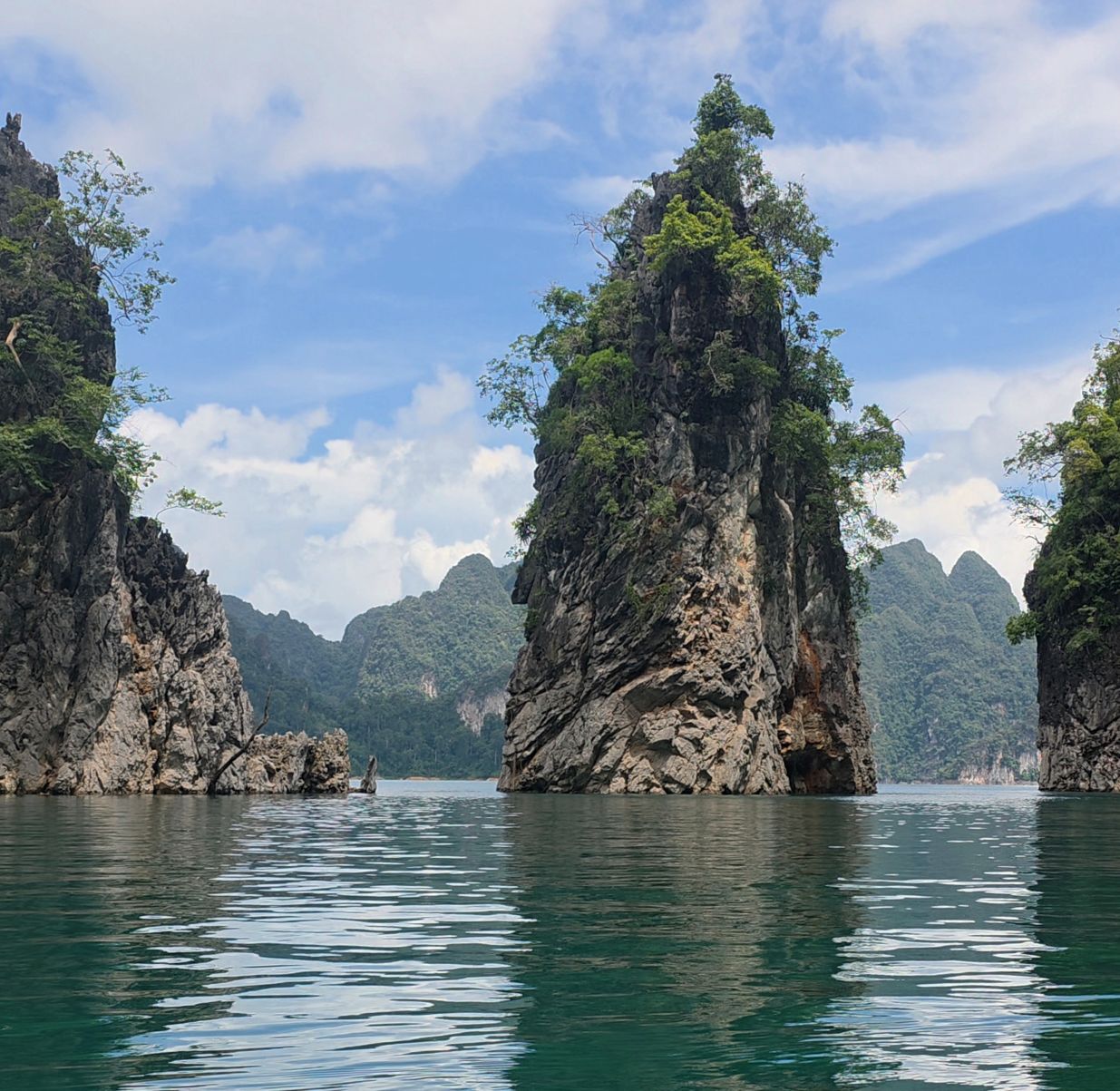
Our long-tail boat pushed away from Rajjaprabha Pier and the landscape gradually opened around us. The water was remarkably still, interrupted occasionally by another boat cutting across its surface. Forest covered the surrounding mountains while immense limestone karsts appeared ahead, their vertical faces rising directly from the water.
Every turn seemed to reveal another version of the same impossible landscape.
It felt ancient.
Untouched.
Almost prehistoric.
Except the water beneath us wasn't supposed to be there.
Only forty years ago, much of what we were travelling across was land.
And beneath the extraordinary beauty of Cheow Lan Lake lies another story entirely.
Before There Was a Lake
The limestone mountains are ancient.
The lake is remarkably young.
Until the 1980s, the landscape beneath our boat was a valley through which the Khlong Saeng River flowed. Communities lived there. People farmed the land. Roads and paths connected homes. Forest stretched between the enormous limestone formations that still dominate the landscape today.
Then Thailand needed something different from the valley.
Electricity.
Water security.
Flood management.
Economic development.
Construction of what was then called Cheow Lan Dam began in February 1982 as part of a major water-resource development project for southern Thailand.
Five years later, the dam was complete.
The valley began filling with water.
What had been hills became islands. Limestone formations that once rose from the valley floor appeared to rise directly from a lake.
The landscape hadn't risen.
The water had risen around it.
By the time the reservoir was complete, approximately 185 square kilometres had been transformed into the body of water we now call Cheow Lan Lake.
In September 1987, King Bhumibol Adulyadej officially inaugurated the dam and hydroelectric power station and bestowed a new name upon it: Rajjaprabha, meaning “Light of the Kingdom.”
It is difficult to imagine a more appropriate name for a project built partly to generate electricity.
But development rarely comes without cost.
The Landscape Beneath Us
As our boat travelled deeper into the lake, understanding what had existed beneath the water changed the way we looked at it.
This wasn't simply flooded forest.
People had lived here.
The construction of the reservoir required 385 households to be relocated from the area that would disappear beneath the rising water. Families were compensated and provided with new land for homes and farming, while government agencies and the Electricity Generating Authority of Thailand worked to establish infrastructure and alternative livelihoods for the relocated communities.
It is easy, decades later, to reduce that history to a statistic.
Three hundred and eighty-five households.
But households are families.
Homes.
Memories.
Places where children grew up.
Land people knew intimately.
Communities don't experience development as numbers on an engineering plan. They experience it personally.
That doesn't make the decision to build the dam inherently right or wrong. It makes the story more complicated than the beautiful landscape we see today.
The same water that displaced one community would eventually provide benefits to many others.
That tension sits quietly beneath Cheow Lan Lake.
And perhaps it should.
The Light of the Kingdom
Rajjaprabha Dam was never built to become one of Thailand's great tourist attractions.
It was infrastructure.
The 94-metre-high rockfill dam was designed as part of a broader strategy to develop southern Thailand's water and electricity resources. Its hydroelectric power station has three generating units with a combined capacity of 240 megawatts and produces hundreds of millions of kilowatt-hours of electricity annually.
But electricity is only part of its purpose.
The enormous reservoir stores water that supports agriculture downstream. During the rainy season, that storage helps mitigate flooding. During drier periods, controlled releases assist agriculture and help manage saltwater intrusion further downstream.
The reservoir also became a freshwater fishery, creating another source of income for surrounding communities.
A project conceived around energy and water gradually became part of the economic and social fabric of the region.
Then something happened that probably wasn't the reason anyone originally flooded the valley.
People came simply to look at it.
When Infrastructure Becomes Beautiful
There is something almost paradoxical about Cheow Lan Lake becoming famous for its natural beauty.
The cliffs are natural.
The rainforest is natural.
The wildlife is natural.
The lake itself exists because people built a dam.
Yet standing on a long-tail boat surrounded by towering limestone formations, the distinction between natural and artificial becomes surprisingly difficult to hold onto.
Nature has reclaimed the edges.
Dense forest descends towards the water. Limestone cliffs disappear beneath its surface. Clouds cling to mountain peaks while reflections stretch across the lake.
Nothing about it feels industrial.
The infrastructure responsible for creating the reservoir gradually disappears behind us, and what remains looks like wilderness.
Tourism followed.
Long-tail boats began carrying visitors into the reservoir. Floating raft houses appeared across the water. Guides began leading people through caves, forests and waterways that had become accessible in entirely new ways.
A landscape transformed for electricity generation had unintentionally created another economy.
Today tourism provides livelihoods for boat operators, guides, accommodation providers, restaurants and communities surrounding the reservoir.
Cheow Lan Lake became something nobody could have fully planned.
A power project became a destination.
Into the Lake
Knowing the history didn't diminish the experience for us.
It deepened it.
As we travelled further across the water, the scale of the landscape became increasingly difficult to comprehend. Limestone formations towered above the boat while narrow passages opened into enormous expanses of water.
The further we travelled, the smaller we felt.
Eventually we reached the formations that have become synonymous with Cheow Lan Lake, three immense limestone pillars rising from the water.
They are often photographed as though they are the destination.
They aren't.
They are punctuation in a much larger story.
The real experience is the journey through the lake itself.
The changing landscape.
The silence when the boat engine slows.
The rainforest stretching towards the shoreline.
The knowledge that somewhere beneath the surface lies another landscape entirely.
Later we stopped at one of the floating raft-house areas, where simple structures seemed almost impossibly isolated from the world we had left behind at the pier.
There are no roads out there.
Water determines how we move.
Boats replace cars.
The mountains decide where passages open and close.
For a few hours, geography takes control again.
Nature Sets the Pace
Our time in Khao Sok had already been teaching us this lesson.
We stayed surrounded by greenery at Hills & Hush Eco Resort, away from the intensity of Thailand's busier destinations. We floated down the Sok River on tubes and allowed the current to decide our speed while jungle passed slowly beside us.
There was something wonderfully simple about surrendering control.
Cheow Lan Lake amplified that feeling.
On the water, there was nowhere to rush.
The boat travelled at the speed the lake allowed. Weather moved across the mountains without consulting our itinerary. The limestone formations determined our route.
We could plan the day.
We couldn't control it.
Perhaps that is part of what makes places like Khao Sok so restorative.
Modern life encourages us to believe that efficiency is progress. Faster transport. Faster communication. Faster decisions.
Nature rarely operates that way.
Rivers flow at their own pace.
Forests grow according to seasons rather than schedules.
Mountains have absolutely no interest in our plans.
Cheow Lan Lake is unusual because human beings dramatically altered that natural system and then, over the following decades, nature absorbed the change.
The result is neither entirely natural nor entirely artificial.
It is something in between.
The Cost of Beauty
Travel photography rarely shows complexity.
A photograph of Cheow Lan Lake shows emerald water, limestone towers and jungle.
It doesn't show electricity travelling through transmission lines towards homes and businesses across southern Thailand.
It doesn't show farms downstream benefiting from managed water.
It doesn't show the families who left the valley before the reservoir filled.
It doesn't show the villages, paths and landscapes that disappeared beneath the water.
And it doesn't show the thousands of livelihoods that tourism now supports around a lake that didn't exist forty years ago.
All of those things can be true at the same time.
Perhaps that is what made Cheow Lan Lake so interesting to us.
The more we learned, the harder it became to describe it simply as beautiful.
Beauty was only the surface.
Beneath it was a story about development, sacrifice, adaptation and the complicated relationship humans have with the natural world.
We alter landscapes to improve our lives.
Then sometimes those altered landscapes begin changing us in ways we never anticipated.
More Than a Day Trip
Many people will visit Cheow Lan Lake because they have seen the photographs.
That is reason enough.
It is unquestionably one of the most spectacular landscapes we have encountered during our travels through Thailand.
But understanding its history transforms the experience.
The limestone cliffs become reminders of the valley that once surrounded them.
The enormous expanse of water becomes evidence of an engineering project that fundamentally changed this part of southern Thailand.
The boats crossing the reservoir represent an economy that emerged after the transformation.
And the name Rajjaprabha, “Light of the Kingdom”, connects the peaceful lake in front of us to the electricity quietly entering Thailand's power system every day.
Cheow Lan Lake isn't simply somewhere beautiful to photograph.
It is a living example of the complicated bargain societies continually make between development and preservation.
There were benefits.
There were sacrifices.
There were consequences nobody could completely predict.
And four decades later, all of them exist together in the same landscape.
Final Reflection
When we first arrived at Cheow Lan Lake, we saw water.
By the time we left, we found ourselves thinking about what lay beneath it.
A river once flowed through this valley.
Families once lived on land now submerged below the surface.
Then people built a dam, the water rose and the geography changed forever.
Electricity followed.
Agriculture benefited.
Floods became more manageable.
Fisheries developed.
Tourists arrived.
And somewhere along the way, one of Thailand's most important pieces of regional infrastructure became one of its most extraordinary destinations.
Perhaps that is why Cheow Lan Lake deserves more than a photograph.
Its beauty is undeniable.
Its story is much more complicated.
We travelled there expecting to experience nature.
Instead, we found ourselves looking at something created by the intersection of nature and human ambition, where ancient limestone mountains rise from a lake younger than many of the people visiting it.
The mountains were always there.
The water was not.
And understanding the difference changed everything we saw.
With perspective,
G&T
Find stories and insights that inspire your own path forward
Discover insights that elevate your travel, sharpen your leadership, and support your personal growth..


Join Our Adventure Today!
Stay updated with our latest travel stories, tips, and adventures. Join our newsletter!