
Following Giants - Koh Lanta Thailand
Discover Following Giants in Koh Lanta, Thailand, where observation-only elephant tourism offers a responsible alternative to riding, feeding and touching elephants
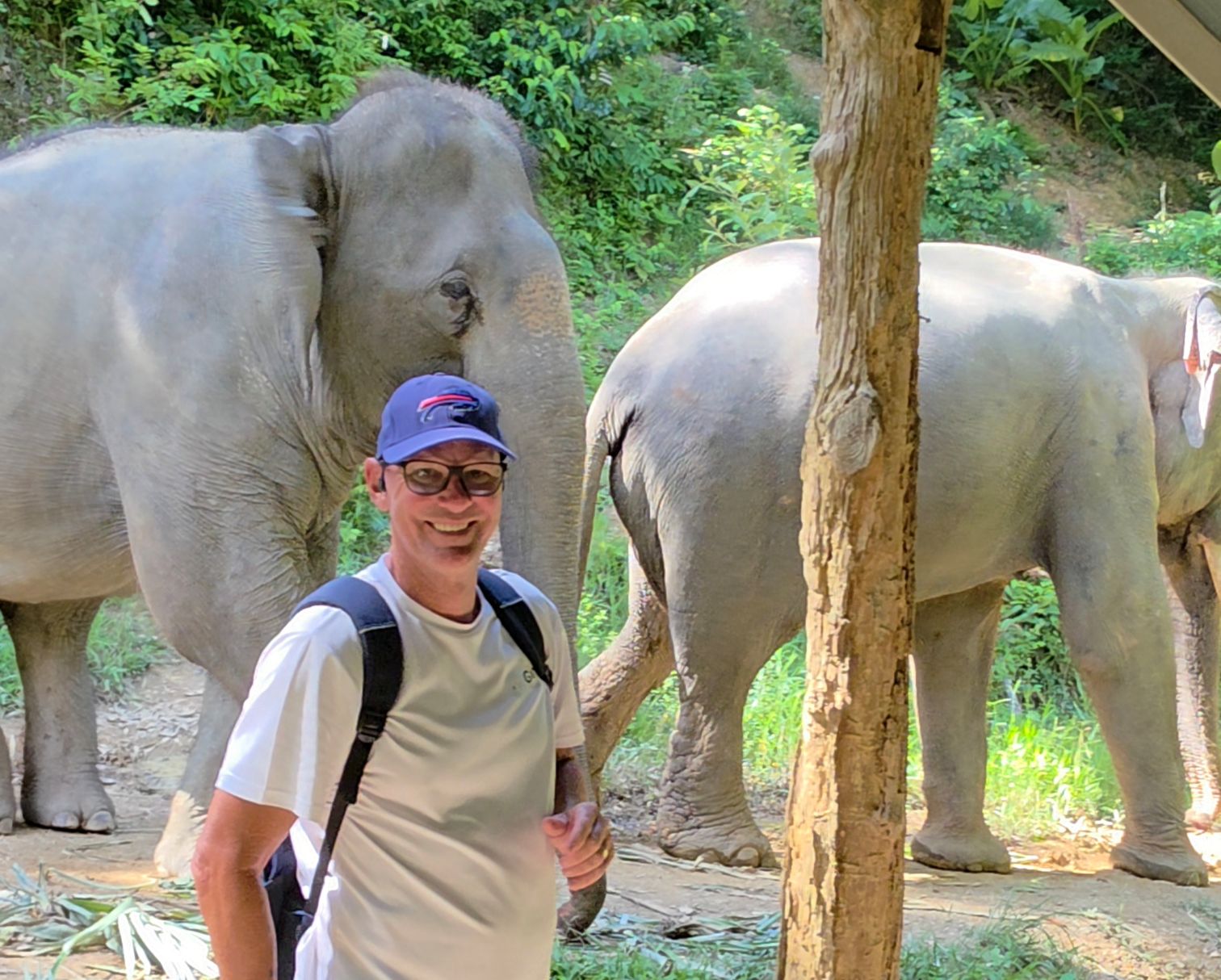
There was a time when getting close to an elephant would have seemed like the ultimate wildlife experience.
Feed one. Touch one. Bathe beside one. Perhaps even climb onto its back.
For generations of travellers through Southeast Asia, photographs of encounters like these became part of the experience. The closer we could get, the more memorable the moment seemed. Tourism responded accordingly, creating opportunities for people to interact with elephants in ways that would have been impossible in the wild.
Our expectations have begun to change.
Ours certainly have.
While travelling through Koh Lanta in southern Thailand, we visited Following Giants, an elephant sanctuary where almost everything we might once have associated with an elephant experience was deliberately absent.
There was no riding.
No bathing.
No feeding.
No touching.
Instead, we walked into the forest with our guide, May, and followed the elephants.
At first, that might sound like we were being offered less.
By the time we left, we understood that was precisely the point.
The Experience We Expected
Elephants occupy a complicated place in Thailand's relationship with tourism.
They are deeply connected to the country's history and culture, but their strength and intelligence have also made them valuable working animals. For generations elephants were used in industries including logging, and as tourism expanded, many became part of an entirely different economy built around rides, performances and direct interaction with visitors.
Following Giants itself emerged from that history.
Its founder, Charae “Ray” Sangkaow, came from a family with generations of experience working with elephants. Before Following Giants existed in its current form, elephants at the Koh Lanta operation we visited were involved in tourism activities including riding. In 2017, Ray began working with World Animal Protection on a different model, and by 2019 the venue had transitioned to observation-only tourism. The elephants gave their final rides and the business became Following Giants.
That history matters because ethical tourism is sometimes presented as though the choices are simple.
They aren't.
Captive elephants cannot simply be released into a forest and expected to survive independently. Following Giants itself acknowledges this reality. Its aim is therefore not to recreate the wild, but to allow elephants already living in captivity to live as naturally as possible, without being required to work for visitors.
For us, that distinction changed the experience completely.
We weren't there to interact with elephants.
We were there to observe them being elephants.
Following Rather Than Leading
Even the name began to make more sense once we entered the forest.
Following Giants.
Not leading them towards tourists.
Not positioning them for photographs.
Not asking them to perform.
Following.
Our guide May, led us along the forest paths while the elephants decided where they wanted to go. We watched them wander through the vegetation, forage for food and disappear partially into the greenery before emerging somewhere further ahead.
There was no carefully choreographed moment when an elephant was brought over to meet us.
If they wanted to move away, they moved away.
If they wanted to stop and eat, we stopped and watched them eat.
And elephants eat a lot.
We learned that they can spend much of their day feeding and consume an extraordinary amount of vegetation relative to their body weight. Managing that appetite is part of caring for captive elephants while also protecting the surrounding forest, which is why food supplementation and habitat restoration form part of the sanctuary's work.
Suddenly an elephant pulling branches apart or searching through vegetation wasn't the boring interval between interactions.
It was the experience.
We had come to watch elephants behave according to their priorities rather than ours.
The Distance Between Us
Perhaps the most interesting part of the experience was becoming aware of the physical space between ourselves and the elephants.
Normally tourism tries to remove that distance.
Closer is better.
Front row is better.
Touching is better.
A photograph beside an animal is better than a photograph from twenty metres away.
Following Giants reverses that logic.
There were moments when an elephant wandered relatively close to us. Occasionally curiosity seemed to get the better of one and a trunk would investigate the air nearby.
But there was an important difference.
We hadn't approached them.
They had approached us.
And when that happened, we didn't reach out to touch them.
The decision belonged to the elephant.
It was such a small distinction, yet it changed the meaning of the encounter.
The moment wasn't valuable because we had finally managed to get close to an elephant. It was valuable because, briefly, the elephant had chosen to get closer to us.
Then it wandered away.
Nothing was demanded in return.
The Baby in the Forest
There was another reason our visit felt particularly special.
Among the elephants was a very young baby boy, born at the sanctuary only months earlier.
Baby elephants possess the same quality as many young animals. They seem simultaneously unaware of their size and endlessly curious about the world around them.
We watched him in the forest as part of the herd, learning simply by being there.
There was no queue of visitors waiting for a photograph with him.
Nobody was allowed to cuddle him.
Nobody was feeding him treats to encourage him closer.
We simply watched.
And somehow that felt more intimate than touching him ever could have.
Perhaps because there was nothing between us and the behaviour we were seeing.
No performance.
No transaction.
Just a young elephant discovering his surroundings while we were fortunate enough to be nearby.
When Tourism Changes
Following Giants also tells a larger story about responsible travel.
It is easy for travellers today to look backwards and judge tourism practices that were once considered normal. Elephant riding appeared in brochures, travel agencies and bucket lists across Southeast Asia for decades. Many travellers participated without understanding what might be required behind the scenes to make such encounters possible.
But expectations change when knowledge changes.
World Animal Protection argues that genuinely elephant-friendly venues should allow elephants space to forage, socialise and behave naturally without forced tourist interactions. It also cautions travellers that words such as sanctuary, rescue centre and retirement home are not guarantees of good welfare. We still need to research what actually happens after visitors walk through the gate.
That last point stayed with us.
Responsible travel isn't simply about choosing something labelled ethical.
It is about asking better questions.
Can we ride the elephants?
Can we bathe with them?
Can we feed them?
Can we touch them?
Perhaps those are no longer questions that should make an elephant experience more attractive.
Perhaps the answer we should increasingly hope to hear is no.
Following Giants made that answer part of its identity.
Its transition also demonstrates why travellers matter. Tourism businesses respond to demand. If visitors expect rides, performances and close physical interaction, businesses have a financial incentive to provide them. When travellers begin choosing observation instead, the incentive changes.
The way we spend our money becomes part of the kind of tourism that survives.
The Strange Privilege of Doing Nothing
As we continued through the forest, something else changed.
We stopped waiting for anything to happen.
At the beginning of many wildlife experiences, there is anticipation. We want the animal to appear. We hope it comes closer. We wait for the perfect photograph or some extraordinary behaviour that will justify the experience.
Eventually, we stopped needing that.
An elephant tearing vegetation from a tree was enough.
Watching another slowly disappear through the forest was enough.
Standing quietly while these enormous animals moved around a landscape on their own terms was enough.
There was something strangely liberating about removing ourselves from the centre of the experience.
Travel often encourages the opposite.
We stand in front of landmarks.
We pose beside views.
We insert ourselves into photographs because the image becomes proof that we were there.
Wildlife doesn't need us in the photograph.
The elephant doesn't know whether we captured the moment.
And perhaps some experiences become more meaningful when we accept that we are not the most important thing happening in them.
Seeing Less
We left Following Giants without ever touching an elephant.
We didn't feed one.
We didn't bathe beside one.
We certainly didn't ride one.
Measured by the traditional language of wildlife tourism, we had done remarkably little.
Yet we had spent hours walking amongst some of the most magnificent animals we had encountered during our travels, learning about their behaviour, their histories, their enormous appetites and the complicated relationship between elephants, people and tourism in Thailand.
More importantly, we had been asked to change our role.
We weren't participants in an elephant experience.
We were guests in theirs.
That distinction may seem small, but it fundamentally changed what we took away from the day.
Final Reflection
Travel constantly encourages us to get closer.
Closer to the view.
Closer to the culture.
Closer to wildlife.
Usually, intimacy is treated as evidence that an experience was somehow more authentic.
Following Giants challenged that assumption.
Sometimes respect requires distance.
Sometimes the best wildlife encounter is one where the animal is allowed to decide what happens next.
And sometimes receiving less from an experience allows us to understand more.
We arrived expecting to see elephants.
We left thinking differently about what it means to see them at all.
Perhaps responsible wildlife tourism begins when we stop asking animals to make our experience memorable and allow ourselves to simply witness theirs.
No feeding.
No touching.
No riding.
Just elephants being elephants.
And for us, that was more than enough.
With respect,
G&T
Find stories and insights that inspire your own path forward
Discover insights that elevate your travel, sharpen your leadership, and support your personal growth..
Join Our Adventure Today!
Stay updated with our latest travel stories, tips, and adventures. Join our newsletter!